Show Related CategoriesCategory
to:
Figurines & Sculptures
Decorative Book
Vase Filler
Statue
Money Box
Bust
Hourglass
Cloches & Water Globes
Crystal
Letter Block
Decorative Bird Houses & Cages
Decorative Slates
Decorative Games & Puzzles
Finial
Decorative Telescope
Decorative Wine Cork Holder
Farmhouse Inspired
Glam Accents
Beach, Coastal & Nautical
Boho Chic
Cool Colored Industrial
Modern Accents
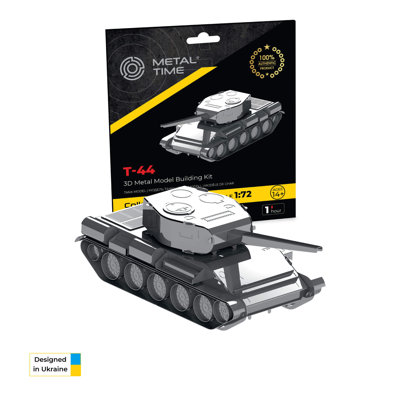
By METAL-TIME
After the cancellation of the T-43, a replacement for the T-34 was still desired and work began on the T-44 in late 1943. Three prototypes were produced, with a 122 mm armed design being rejected. The 85 mm variant was accepted for production, which commenced in 1944 and the tank remained in service until the 1970s. The medium tank “T-44” could have become the best tank of World War II, but it never fired a shot on the battlefield. This combat vehicle was created in 1943 but never came into the front lines. In the last years of the war, the Soviet command realized that despite their quantity and decent mobility and reliability, the “T-34” tanks, even with the 85mm gun modification, were inferior to the best German armored vehicles - the “Tiger II” and “Panther” tanks. In head-to-head battles, the Soviet tanks had no chance due to their weak armor protection. Therefore, it was decided to create a tank with similar mobility and long-range capabilities as the “T-34”, but with significantly reinforced frontal armor. Thus, the “T-44” was born. It underwent significant modifications. The decision was made to abandon the Christie suspension, and increase the power of the gun while maintaining the advantages of a medium "cruiser" tank. The result was a powerful, fast, and well-protected combat vehicle capable of combining the armor protection of a heavy tank with the mobility of a medium one. Modifications were released with 100 mm and even 122 mm caliber guns, but due to the vehicle's weight increase, they had to be abandoned in favor of the 85 mm gun created based on the rapid-fire D5-T gun. Despite its worthy characteristics, the “T-44” was not put into mass production until the end of World War II, so as not to disrupt the production cycle of the “T-34-85”, which had similar parameters. However, after the war, the tank was produced in large batches and remained in service with the Soviet army until the 1970s.
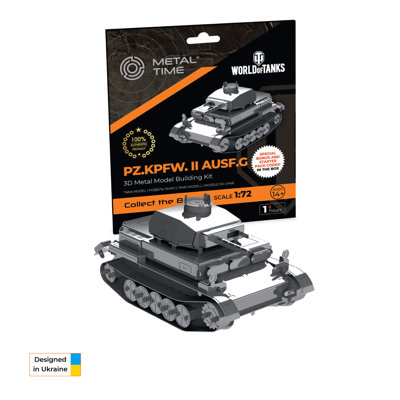
By METAL-TIME
On June 18, 1938, MAN and Daimler-Benz received an order for an initial batch of 75 Pz II Ausf. G tanks. A prototype was manufactured in 1939. The vehicle was produced from April 1941 through February 1942, with a total of only 12 tanks built. World War II brought armored vehicles to the forefront, making them the main striking force. But it all began not with heavy, unstoppable, powerful machines with siege weapons, but with small maneuverable tanks. One of the remarkable examples of engineering creativity of the 1940s is the German "Panzer II Ausf G". A chain of modifications to the basic model, which was one of the most numerous tanks until 1942, led to its appearance. The "Panzer II Ausf G" significantly increased in speed. Unlike its rather slow predecessor, it could reach speeds of up to 50 km/h on the highway, which improves its mobility. Due to its good maneuverability, this light tank could perform tasks of escorting and providing fire cover for infantry even better. Its armor was sufficient to protect against small arms and mines, but artillery strikes became fatal for the Panzer II. The main weapon of the "Panzer II Ausf G" remained the 20mm automatic cannon and the 7.92mm MG-34 machine gun. The main protection was the turret design with ricochet angles, which allowed to soften or deflect enemy shell hits. The “Panzer II Ausf G” crew consisted of three people. Unlike the previous model, the driver and radio operator received viewports in the front and sides of the hull, improving the combat vehicle's maneuverability.
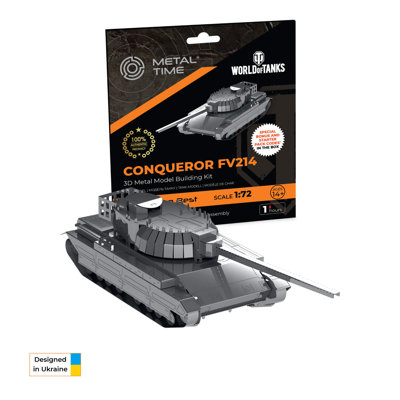
By METAL-TIME
The FV214 Conqueror was conceived in 1946 as a response to two other categories of vehicles: the German panzer tanks that had demonstrated superior firepower during World War II, and the Soviet IS-3 heavy tank that entered service in 1945. The Conqueror’s 120mm gun was considered an advantage, but tank crews generally found the vehicle difficult to maneuver. Once the Centurion was outfitted with a 105mm gun, the Conqueror was withdrawn from use in the 1960s. Large-scale battles did not accompany the Cold War on the battlefield. But fierce battles raged in the design bureaus. New military challenges demanded new technical solutions. British engineers, abandoning the idea of "cruiser" tanks, began to develop heavy ones. One of the promising models was the FV 214 "Conqueror". The project of the over 60 tons tank appeared in 1949, but this tank went into serial production only in 1955. The main weapon of the tank was a 120-mm gun. The length of the fighting vehicle together with the cannon was more than 11 meters. The engine with a power of 810 hp drove this huge thing with a speed of up to 35 km/h on a hard surface. The aiming fire could be made only from a standing position. In combat, the main firepower of the "Conqueror" was two 7.63 mm M1919 machine guns. Distinctive features of the tank's architecture were a turret and hull with ricochet panels and a chassis with four bogies of two rollers and two drive wheels. The crew of the heavy tank consisted of four men. The mechanic driver was in the platform and three other soldiers were in the turret. There was also a commander's turret with all-round visibility. In addition to combat duty in the British Armed Forces, the "Conqueror" was a testing ground for engineering research. Its weak point was considered insufficient protection, but this was corrected in the new modifications. However, the tank could not withstand competition with other models and its production was stopped by the 60s.
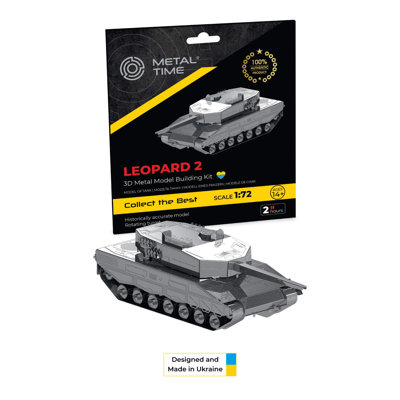
By METAL-TIME
The Leopard 2 is a third generation German main battle tank (MBT). Various iterations of the Leopard 2 continue to be operated by the armed forces of Germany. The Leopard 2 is a third generation German main battle tank (MBT). Developed by Krauss-Maffei in the 1970s, the tank entered service in 1979 and replaced the earlier Leopard 1 as the main battle tank of the West German army. Various iterations of the Leopard 2 continue to be operated by the armed forces of Germany, as well as 13 other European countries, and several non-European countries, including Canada, Chile, Indonesia, and Singapore. Some operating countries have licensed the Leopard 2 design for local production and domestic development. There are two main development tranches of the Leopard 2. The first encompasses tanks produced up to the Leopard 2A4 standard and are characterised by their vertically faced turret armour. The second tranche, from Leopard 2A5 onwards, has an angled, arrow-shaped, turret appliqué armour, together with other improvements. The main armament of all Leopard 2 tanks is a smoothbore 120 mm cannon made by Rheinmetall. This is operated with a digital fire control system, laser rangefinder, and advanced night vision and sighting equipment. The tank is powered by a V12 twin-turbo diesel engine made by MTU Friedrichshafen. Following the end of the Gilded Leopard study in 1967, the West German government decided to focus on the Experimentalentwicklung (experimental development) in a feasibility study and to develop new components for upgrading the Leopard 1 and for use on a future main battle tank programme. At first 25 million DM were invested, but after the industry came to the conclusion that with such a low budget the development of the two projected testbeds was not possible, a total of 30 to 32 million DM was invested. The experimental development was contracted to the company Krauss-Maffei, but with the obligation to cooperate with Porsche for the development of the chassis and with Wegmann for the development of the turret.

By Happy Larry
Rated 4.9 out of 5 stars33 total votes
Absolutely beautiful. Very well made and really cute. It sums up how my friend and I feel about our friendship. Great customer service and quick delivery. Good packaging. Many thanks. Maureen. Manchester. Mon Jan 26 2026
3 Colours, 2 Sizes
By Wade Logan
Rated 4.6 out of 5 stars136 total votes
Get it by Thu, 14 May
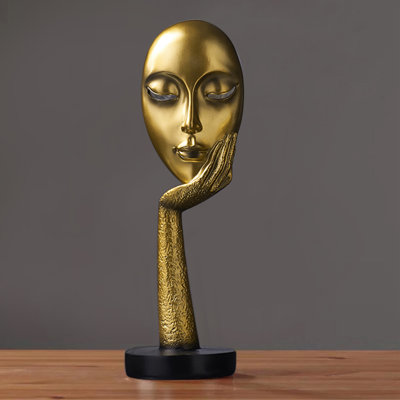
Inspired by the thinker and meditator trend, this statue by Livingandhome features an abstract woman face who is holding her face. The whole figurine shows a sense of understated beauty and elegance. Looking at the statue can bring your mind to a calm and peaceful state, it can be an amazing addition to any household decor. Introduce it to your home for an enhanced artistic atmosphere.
Got this in gold and I absolutely love it! Suits my media wall very well. Loads of compliments from guests. Anonymous. Sat Dec 13 2025

Earn {RICH_TEXT_POTENTIAL_REWARDS} in rewards today, plus free standard delivery² on future purchases & more after you join.Earn £5.90 in rewards today, plus free standard delivery² on future purchases & more after you join.
Free Delivery
Get it by Tue, 26 May