Show Related CategoriesCategory
to:
Figurines & Sculptures
Decorative Book
Vase Filler
Statue
Money Box
Bust
Hourglass
Cloches & Water Globes
Crystal
22 Items

By Borough Wharf
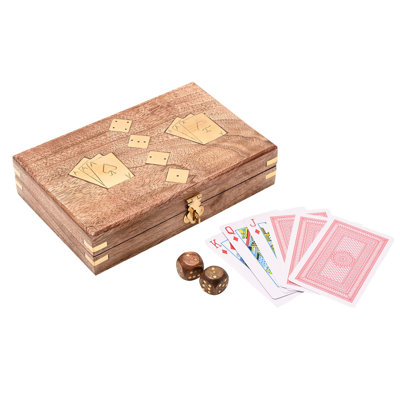
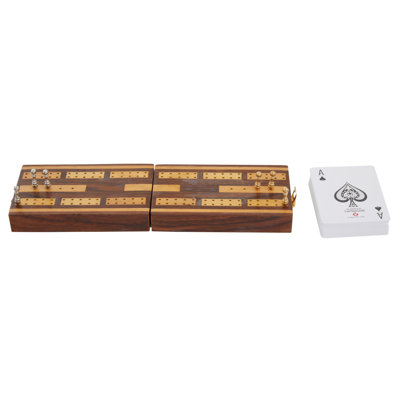
Elevate your games night with this Wooden Cards and Dice Set from Harvey Makin®. The set includes a premium lidded gift box and a sustainable rosewood case featuring an elegant brass inlay design of cards and dice. Inside, you’ll find a standard 52‑card deck along with five rosewood dice, each crafted with inlaid brass dots for a refined finish. This beautifully presented set makes the perfect gift for any discerning gentleman.

Get it by Thu, 14 May
Skilfully made from premium quality MDF and given resin coating, this card box exhibits a white ace symbol on the black surface of the box. This minimal yet decorative case comes with a removable lid and houses a deck of playing cards.

By METAL-TIME
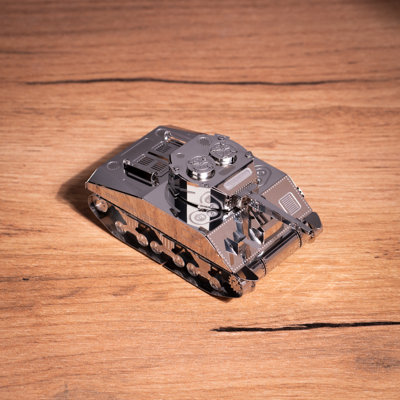
The first production version of the Sherman, the most common American tank, with an amazing total of 49,234 vehicles manufactured. The Sherman first saw combat in North Africa. The medium tank "M4" is one of the most mass-produced tanks of World War II. It stands alongside other legendary "victory tanks" as it successfully fought in many local conflicts even after the war. The "Sherman," named after a hero of the American Civil War, has become the subject of numerous books, films, and comics. Its successful design and the possibility of modifications made this tank almost irreplaceable in battles. The "M4" began serial production in 1942 and was adopted by the United States, Great Britain, and the Soviet Union. Over 50,000 tanks of various modifications were produced, but they all retained the original design. The "Sherman" was operated by two driver mechanics on the main platform, and three crew members in the turret were responsible for its combat power. The main weapon of the "M4" was a 75mm tank gun. In some modifications, it was a mortar or even a flamethrower. Machine guns or automatic cannons were used for close combat. The chassis consisted of three bogies with two rollers each on a spring suspension and leading wheels.

By METAL-TIME
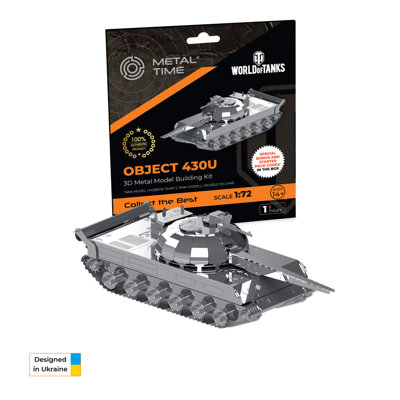
A prototype of this medium tank was developed from 1953 through 1957 to replace the T-54. Several prototypes were manufactured. Later, Soviet authorities wanted a tank with greater nuclear survivability and firepower. As a result, the project was discontinued in 1961, and the decision was made to develop the Object 432. After summing up the results of World War II and analyzing the effectiveness of all types of armaments, the Soviet government thought about the need to modernize its fleet of armored vehicles. First, there was a need to replace the T-54 medium tank, which would correspond to modern realities. Hence, in 1953, a new tank project was initiated, generically named “Object 430”. Several modifications of the fighting vehicle were developed under this name, which later became a basis for the development of “T-64”. In “Object 430” the changes concerned the location and configuration of the engine and the whole engine-transmission compartment. The engine was located across the driving direction in the aft compartment, allowing to expand of inner space for the 4-person crew and ammunition. A characteristic shape of the tank was a hemispherical turret with 248 mm armor at the front and a slot for the main gun - 100 mm D-54TS gun. There was also provision for a 14.5-mm anti-aircraft machine gun KPVT. "Object 430" in later modifications was successfully tested, however, it did not show a significant advantage over the obsolete “T-54”. In 1961 the project was stopped. Successful engineering solutions were taken over by the "Object 432", which eventually evolved into the mass-produced “T-64”.

By METAL-TIME
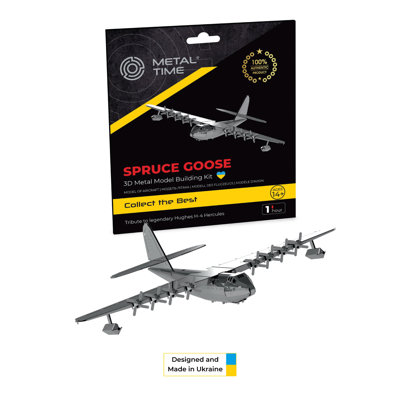
The Hughes H-4 Hercules (commonly known as the Spruce Goose) is a prototype strategic airlift flying boat designed and built by the Hughes Aircraft Company. Intended as a transatlantic flight transport for use during World War II, it was not completed in time to be used in the war. Here history takes flight with the SPRUCE GOOSE steel DIY model kit by Metal Time Models. Step into the golden age of aviation and relive the marvel of the Hughes H-4 Hercules, affectionately known as the Spruce Goose. This steel model kit pays homage to the iconic prototype strategic airlift flying boat designed and built by the legendary Hughes Aircraft Company. Crafted with precision and passion by Metal Time Models, the SPRUCE GOOSE DIY model kit allows enthusiasts of all ages to recreate the awe-inspiring design of this colossal flying machine. The Hughes H-4 Hercules was conceived as a transatlantic flight transport during World War II, but despite its grand aspirations, it was not completed in time for wartime service. Now, you have the chance to build a stunning steel replica of this historic aircraft.

By METAL-TIME
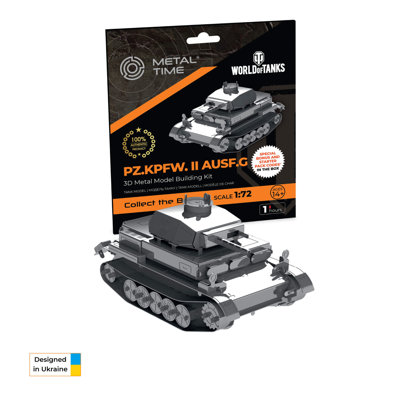
On June 18, 1938, MAN and Daimler-Benz received an order for an initial batch of 75 Pz II Ausf. G tanks. A prototype was manufactured in 1939. The vehicle was produced from April 1941 through February 1942, with a total of only 12 tanks built. World War II brought armored vehicles to the forefront, making them the main striking force. But it all began not with heavy, unstoppable, powerful machines with siege weapons, but with small maneuverable tanks. One of the remarkable examples of engineering creativity of the 1940s is the German "Panzer II Ausf G". A chain of modifications to the basic model, which was one of the most numerous tanks until 1942, led to its appearance. The "Panzer II Ausf G" significantly increased in speed. Unlike its rather slow predecessor, it could reach speeds of up to 50 km/h on the highway, which improves its mobility. Due to its good maneuverability, this light tank could perform tasks of escorting and providing fire cover for infantry even better. Its armor was sufficient to protect against small arms and mines, but artillery strikes became fatal for the Panzer II. The main weapon of the "Panzer II Ausf G" remained the 20mm automatic cannon and the 7.92mm MG-34 machine gun. The main protection was the turret design with ricochet angles, which allowed to soften or deflect enemy shell hits. The “Panzer II Ausf G” crew consisted of three people. Unlike the previous model, the driver and radio operator received viewports in the front and sides of the hull, improving the combat vehicle's maneuverability.

By METAL-TIME
Concorde is a tailless aircraft design with a narrow fuselage permitting a 4-abreast seating for 92 to 128 passengers, an ogival delta wing and a droop nose for landing visibility. Thrill of supersonic travel takes center stage with the SUPERSONIC LEGEND steel DIY model kit by Metal Time Models. Dive into the exhilarating world of aviation and celebrate the iconic Concorde, a true marvel of aerospace engineering. Crafted with precision and passion, this DIY model kit captures the essence of the legendary supersonic aircraft. The Concorde, known as the SUPERSONIC LEGEND, is brought to life through meticulously cut steel components that ensure a seamless and satisfying building experience. This tailless aircraft design features a narrow fuselage, allowing for a 4-abreast seating configuration catering to 92 to 128 passengers. The distinctive ogival delta wing and the droop nose, designed for enhanced landing visibility, are intricately represented in this model, paying homage to the unique features that set the Concorde apart.

By METAL-TIME
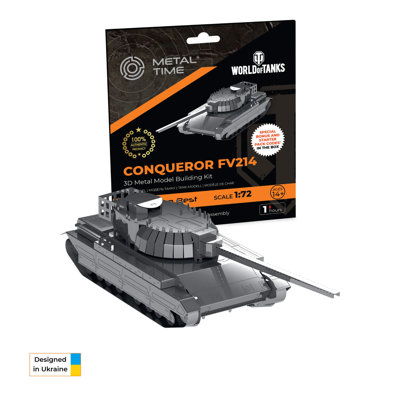
The FV214 Conqueror was conceived in 1946 as a response to two other categories of vehicles: the German panzer tanks that had demonstrated superior firepower during World War II, and the Soviet IS-3 heavy tank that entered service in 1945. The Conqueror’s 120mm gun was considered an advantage, but tank crews generally found the vehicle difficult to maneuver. Once the Centurion was outfitted with a 105mm gun, the Conqueror was withdrawn from use in the 1960s. Large-scale battles did not accompany the Cold War on the battlefield. But fierce battles raged in the design bureaus. New military challenges demanded new technical solutions. British engineers, abandoning the idea of "cruiser" tanks, began to develop heavy ones. One of the promising models was the FV 214 "Conqueror". The project of the over 60 tons tank appeared in 1949, but this tank went into serial production only in 1955. The main weapon of the tank was a 120-mm gun. The length of the fighting vehicle together with the cannon was more than 11 meters. The engine with a power of 810 hp drove this huge thing with a speed of up to 35 km/h on a hard surface. The aiming fire could be made only from a standing position. In combat, the main firepower of the "Conqueror" was two 7.63 mm M1919 machine guns. Distinctive features of the tank's architecture were a turret and hull with ricochet panels and a chassis with four bogies of two rollers and two drive wheels. The crew of the heavy tank consisted of four men. The mechanic driver was in the platform and three other soldiers were in the turret. There was also a commander's turret with all-round visibility. In addition to combat duty in the British Armed Forces, the "Conqueror" was a testing ground for engineering research. Its weak point was considered insufficient protection, but this was corrected in the new modifications. However, the tank could not withstand competition with other models and its production was stopped by the 60s.

By METAL-TIME
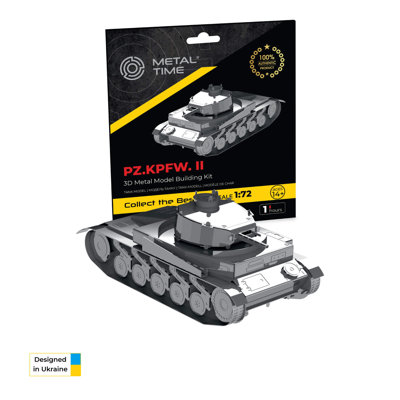
The last modification of the light Pz. II tank. The vehicle featured enhanced armor, the 2 cm KwK 38 gun and improved observation devices. A total of 524 vehicles were built from March 1941 through December 1942. This may sound strange, but the iron mechanical power of the Wehrmacht in World War II began with... a tractor. It was under the name "agricultural tractor LaS 100" that Germany produced the first combat tanks of the largest war of the 20th century. The modification of the basic model Panzer I became the light tank “Panzerkampfwagen II” or “Pz.Kpfw. II”. It was one of the most mass-produced combat vehicles of World War II. By 1942, when they gave way to heavy machines, more than 3,500 of them had been produced. This not-fast tank, weighing about 8 tons, could reach a speed of 40 km/h on the highway and was designed to cover infantry attacks. Its armor was sufficient to protect against small arms and mines, but artillery strikes were fatal to the Panzer II. Moreover, its firepower was hardly impressive. The main weapon of the tank was a 20mm automatic cannon. There were several weapons options - tank modifications with flamethrower systems and heavy machine guns as the main weapon exist. The main protection was the turret design with ricochet angles, which allowed for the softening or reflecting of enemy weapons hits.

By METAL-TIME
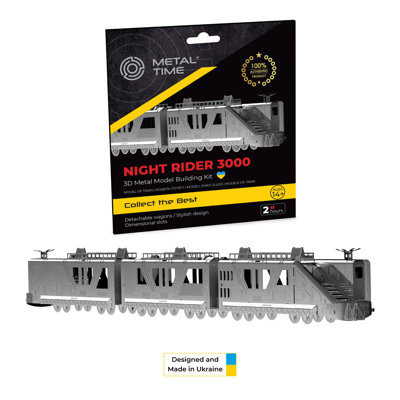
The Night Rider train is an imaginary train set in a fictional post-apocalyptic future. It crosses the desert only at night due to the impossibility of movement during the day due to the high air temperature. The Night Rider is a fully armored train often used to transport valuable passengers and cargo. Explore the thrilling world of the Night Rider 3000 DIY model kit, a captivating representation of an imaginary train set in a fictional post-apocalyptic future. This meticulously crafted steel model captures the essence of an armored train that braves the desert only under the cover of darkness, navigating the unforgiving landscape where daytime temperatures soar to extremes. The Night Rider 3000 is not just a model; it's a journey into a dystopian world where creativity knows no bounds. This DIY kit allows enthusiasts of all ages to bring the mystique of this fully armored train to life with their own hands. Each piece is precision-cut from high-quality steel, ensuring a satisfying building experience and a durable final product that can stand the test of time.

By METAL-TIME
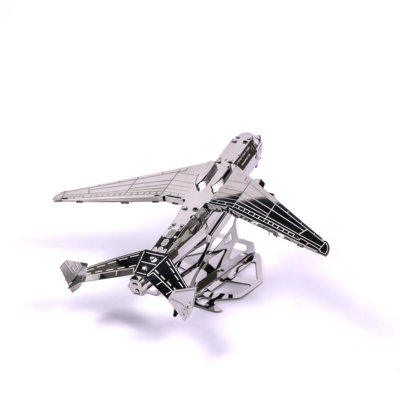
Together with Antonov, Metal Time supports Ukrainian aviation rebuilding programs, including: - the restoration of the AN-225 Mriya aircraft; - training of new pilots and aircraft engineers; - the restoration of houses of Antonov employees, destroyed during the war. In 1988, Antonov Aviation built the world's largest cargo aircraft, the AN-225, named Mriya (translated from Ukrainian, means Dream) and landed it at the Gostomel airport, in Kyiv, Ukraine. Its specifications were astonishing: it was 275 feet long, 288 feet wide and 59 feet tall. To understand just how enormous Mriya was imagine a six-story house with four entrances. The Mriya weighed 350 tons (700,000 lbs.) and could lift another 250 tons (500,000 lbs.). This was an absolute record. Mriya was a beast. No plane on earth could come close to that much carrying capacity. For example, Mriya could transport a herd of 42 elephants, or more than 1.8 million iPhones. Over the years, the Mriya AN-225, has transported giraffes, yachts, parts of power plants and other large items other planes could not transport. Mriya carried the first Soviet "Shuttle" called "Buran" made its longest flight. After a short flight into space, the Buran remained grounded, but the Mriya would continue to soar! Such an amazing feat of engineering has rarely been seen on earth. Each takeoff and landing of the Mriya became spectacle, attracting the press and people from all over the world. You can destroy a plane, but you can't kill a Dream. One day Mriya will fly again. In memory of the amazing, unique, aircraft, Metal Time presents the Ukrainian Dream SE licensed model. It is the result of a collaboration initiative between Antonov, Metal Time, and the Ukrainian Postal Service, Ukrposhta. Ukrainian Dream is an officially licensed model. So, we have paid great attention to every possible detail. The design case and movement were designed with great precision, to ensure each part moved correctly, and was visually accurate. The aircraft rests on a stand and can be easily removed. In addition to all necessary parts for assembly, the set includes the limited-edition Mriya the Dream” postage stamp. Along with the Stamp, is a certificate of appreciation and support from Antonov Aviation, documenting your support of Mriya, and the aviation rebuilding programs. Together with Antonov, Metal Time supports Ukrainian aviation rebuilding programs, including: - restoration of the AN-225 Mriya aircraft; - training of new pilots and aircraft engineers; - restoration of houses of Antonov employees, destroyed during the war.

By METAL-TIME
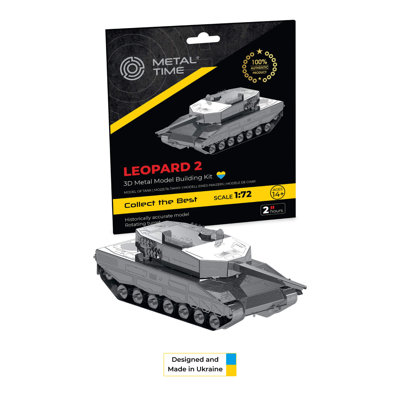
The Leopard 2 is a third generation German main battle tank (MBT). Various iterations of the Leopard 2 continue to be operated by the armed forces of Germany. The Leopard 2 is a third generation German main battle tank (MBT). Developed by Krauss-Maffei in the 1970s, the tank entered service in 1979 and replaced the earlier Leopard 1 as the main battle tank of the West German army. Various iterations of the Leopard 2 continue to be operated by the armed forces of Germany, as well as 13 other European countries, and several non-European countries, including Canada, Chile, Indonesia, and Singapore. Some operating countries have licensed the Leopard 2 design for local production and domestic development. There are two main development tranches of the Leopard 2. The first encompasses tanks produced up to the Leopard 2A4 standard and are characterised by their vertically faced turret armour. The second tranche, from Leopard 2A5 onwards, has an angled, arrow-shaped, turret appliqué armour, together with other improvements. The main armament of all Leopard 2 tanks is a smoothbore 120 mm cannon made by Rheinmetall. This is operated with a digital fire control system, laser rangefinder, and advanced night vision and sighting equipment. The tank is powered by a V12 twin-turbo diesel engine made by MTU Friedrichshafen. Following the end of the Gilded Leopard study in 1967, the West German government decided to focus on the Experimentalentwicklung (experimental development) in a feasibility study and to develop new components for upgrading the Leopard 1 and for use on a future main battle tank programme. At first 25 million DM were invested, but after the industry came to the conclusion that with such a low budget the development of the two projected testbeds was not possible, a total of 30 to 32 million DM was invested. The experimental development was contracted to the company Krauss-Maffei, but with the obligation to cooperate with Porsche for the development of the chassis and with Wegmann for the development of the turret.

(Set of 3)
By Fairmont Park
Tarot Cards & Crystal Set by The Seasonal Gift Co.® This full deck of Tarot Cards is presented in a black velvet gift pouch with gold detail, complete with a helpful instruction guide. Tarot promotes intuitive discovery. By engaging in the ritual of reading cards, gives you the opportunity to truly listen to what your heart is telling you. Make your own interpretation of your chosen cards and enjoy the path to personal discovery. Contains: Velvet carry pouch Full deck of 78 Tarot Cards - 56 Minor Arcana and 22 Major Arcana cards. Instruction booklet with reading meanings 7 Tarot Crystals: Green Aventurine - provides strength & confidence Red Jasper - provides endurance, grounding, and nurturing energy Tigers Eye - bringer of good luck Lapis Lazuli - heightens psychic abilities, wisdom, and power Amethyst - represent purification and helps with spiritual connections Black Obsidian - increases self-control and self-awareness Clear Quartz - provides purifying energy

By METAL-TIME
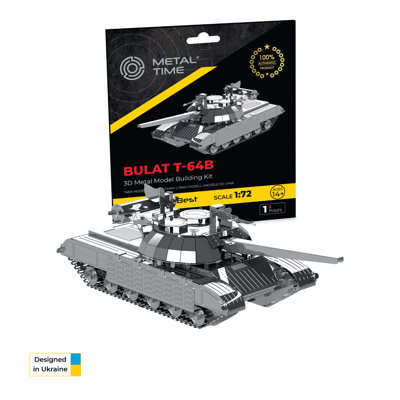
The modernisation programme, transforming T-64 MBTs to BM Bulat MBTs, focused on improvement of its fire power, mobility and protection. The upgraded sights and aiming devices include a Buran-E night vision system for detection, identification and engagement of targets, and a TKN-4S, the sighting system for the tank commander. The modernisation work included installation of a 1G46M sight and a TO1-KO1ER night sighting system or Buran-Catherine thermal imager for the gunner, some 2E42M main armament stabiliser units, a 1V528-1 tank ballistic computer, a TAKO-621 guided weapon system, a 1ETs29M control system for anti-aircraft machine guns and a PNK-5SR observation and sighting system. The “Bulat” T-64 is the main battle tank of the Ukrainian Armed Forces. It is the result of a rethinking and deep modernization of the Soviet T-64 tank. Over decades of painstaking work, designers were able to bring the fire control, protection, and firepower systems up to the level of modern T-80 and T-84 models. Due to its predecessor, “Bulat” has a recognizable design: side protection side screens, a low-profile turret equipped with passive protection plates, and an ammunition bunker. “Bulat” T-64 is one of the main mechanized combat units in the Ukrainian army. Inheriting the simplicity of the base model, it has significantly improved in characteristics. This combat vehicle can reach speeds of up to 60 km/h on the highway and has a combat range of up to 385 km. The turret turning speed is 40 degrees per second, allowing the tank to quickly respond to threats.

By METAL-TIME
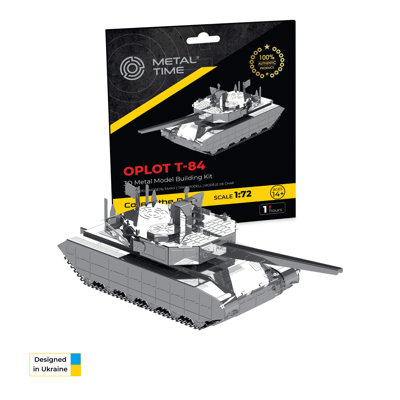
The T-84 is a Ukrainian main battle tank (MBT), based on the Soviet T-80 main battle tank introduced in 1976. The T-84 was first built in 1994 and entered service in the Ukrainian Armed Forces in 1999. The T-84 is based on the diesel-engined T-80 version, the T-80UD. Its high-performance opposed-piston engine makes it a fast tank, comparable to other modern MBTs with a power-to-weight ratio of about 26 horsepower per tonne (19 kW/t). The T-84 Oplot is an advanced version incorporating an armoured ammunition compartment in a new turret bustle. Ten of these entered Ukrainian service in 2001. The T-84-120 Yatagan is a prototype model intended for export, mounting a 120 mm gun capable of firing standard NATO ammunition and guided missiles. Main Battle Tank "Oplot" is the pinnacle of tank development in Ukraine and one of the best tanks designed and produced in series in the post-Soviet space. Based on the Soviet model T-80, "Oplot" underwent almost ten deep modernizations until it met NATO standards and became part of the family of advanced European combat vehicles. "Oplot" T-84 is equipped with a 1200 hp engine 6TD-2E, capable of reaching a speed of up to 70 km/h on the highway and operating at up to 450 km. The tank's armament consists of a main 125 mm gun, a 12.7 mm anti-aircraft machine gun, and paired 7.62 mm machine guns. Digital and analog equipment for the commander's console, targeting systems, and a multi-level protection system, including anti-nuclear protection, make this combat vehicle one of the effective European tanks. Successful tests in real combat conditions during the Russian-Ukrainian war only add to this model's score, as it has demonstrated its ability to actively engage in combat, protect, and effectively destroy enemy vehicles and personnel.

By METAL-TIME
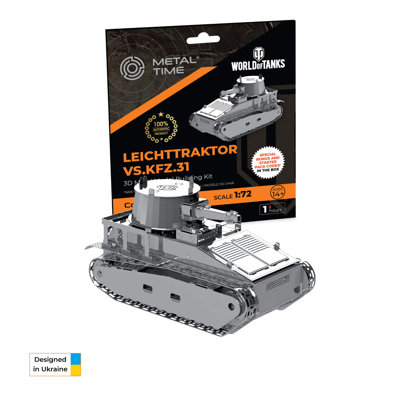
The Vs.Kfz.31 Leichttraktor (Light tractor), also known at the time as the Kleintraktor (Small tractor), was a prototype German light tank, of which four distinct versions were made. It was developed and tested in secret at the Soviet-German Kama facility, during the Weimar Republic. This was part of the Leichttraktor, also known as the Kleintraktor, project. The tank was designed *around* 1929 and used through early WW2 as a training vehicle. In spite of having a 37 mm cannon, it was rejected in favor of the Panzer I, in a competition to make a new light tank for Germany, like the Grosstraktor project at the same time. The German Wehrmacht started World War II... with tractors. That is what the first German tanks were called. This happened because, under the terms of the Treaty of Versailles, which witnessed the defeat of Germany in World War I, the country was not allowed to develop and produce heavily armored fighting vehicles. Therefore, these products had the name of civil technology, and it was not far from the truth. The first samples of German tanks were modernized tractors. An example of this is the Leichttraktor Vs. Kfz.31 light tank. The development of the tank was carried out by two well-known manufacturers of first-class military equipment: “Krupp” and “Rheinmetall”. They presented two models that differ from each other in some detail. But the main ones were the same. The first tank "Leichttraktor Vs. Kfz.31" was created on a tractor chassis with 12 rollers, combined into six carts. The chassis was covered with an armor shield, however, the design of the tracks and suspension was vulnerable even to large-caliber small arms. The “Daimler Benz” engine with 100 hp the designers placed it in front, which was a controversial decision. On the one hand, he covered the crew of 4 people, and on the other hand, he was vulnerable to the enemy and increased the risk of immobilizing the combat vehicle in the battle. The welded-riveted turret was moved back, which made the tank look like a self-propelled gun, however, the armament of the "Leichttraktor Vs. Kfz.31" was not very powerful. The main gun was a 37 mm KwK 36 L/45 cannon, and a 7.92 mm Dreyse machine gun was also mounted on the tank.

By METAL-TIME
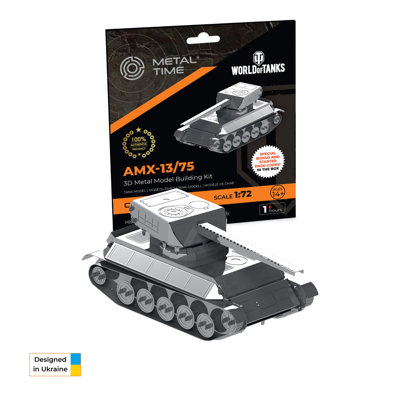
Maneuverable light tank with an oscillating turret and a 75 mm autoloader gun that could fire up to 10 shots per minute. At that time, the gun on this vehicle had superior penetration compared to the guns of most other medium tanks. The tank has a decent top-end gun and good dynamic performance. In the last years of World War II strategists and manufacturers of military equipment began to think about new generations of weapons. And one of the successful embodiments of the new concepts of armored fighting vehicles was the French light tank "AMX-13". Its first prototypes appeared in 1945 and its subsequent modifications were used in military operations until the XXI century. This maneuverable tank with a length of 5 meters and a height of 2.4 m originally possessed several unique design features. The most important of these was the "rocking" turret. The main design principle was that after the gun had fired, returning impulse was delivered to the turret and caused a new shell to move to the breech block of the gun and the loader mechanism to push it inside the barrel. This allowed automatic firing at a rate of up to 12 rounds per minute! Considering that such tanks were equipped with a 75-mm gun, this turned the tank into a vehicle for the continuous destruction of everything in the line of fire. Further modifications of the "AMX-13" were equipped with 100-mm and even 155-mm guns. In such a form it could compete with medium tanks and mobile guns. However, another difference of this tank was its speed. It could reach up to 60km/h on a hard surface (up to 400km), get over obstacles up to 60cm high, ditches up to 1.5m deep, and water obstacles up to 0.8m deep. Along with the brilliant characteristics, "AMX-13" also had disadvantages. It had weak armor, which was typical of light tanks, and the downside of rapid fire - the need to replenish ammunition. When the shells ran out in combat, the tank became unarmed and was often doomed to destruction.

By METAL-TIME
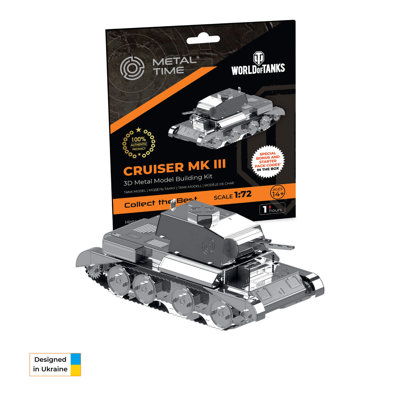
Developed by extensively upgrading two prototype M1931 Christie tanks purchased by the British Army in 1936. The vehicle was designed to be a fast, lightly-armored breakthrough tank. The modified design was deemed successful and became the basis for other cruiser tanks. Sixty-five vehicles of this type were built and saw combat in France and North Africa in 1940 and 1941. The British army began to prepare for the inevitable war at the beginning of the 30s. The industry was moving to a military footing, engineers were looking for advanced solutions for military equipment. American designer D. W. Christie created a chassis of four full-size rubber-coated rollers, planted on spring shock absorbers and two drive gears that move the trucks. This invention was so successful that it gave birth to several generations of tanks. One of the first was the English "cruising" tank "Cruiser Mark III". This light tank had a high speed, up to 50 km/h on a hard road, the ability to overcome obstacles up to 0.6 m high, and a powerful main gun - a 40 mm “QF 2 pounder” anti-tank gun. She was supplemented by a 7.7 mm “Vickers” machine gun. Under the ventilation grilles at the rear of the "Cruiser Mark III" was a 340 hp “Nuffield Liberty” 12-cylinder aircraft engine, superior in power to all similar combat vehicles of the time. The crew consisted of a driver, gunner, loader, and commander. With all these significant advantages, the tank had an important drawback: weak armor protection. Therefore, it was not used as an assault combat vehicle, but provided infantry cover, following more powerful tanks on the battlefield. The British lost dozens of "Cruiser Mark III"s in the fighting in France and brought these vehicles to less hot parts of the front. The era of the American “M4 Sherman” and British medium tanks in 1942 doomed cruiser tanks to oblivion.

By Astoria Grand
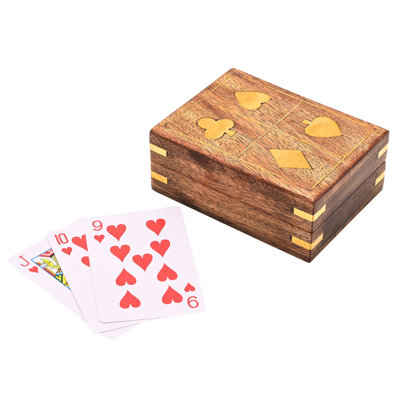
Add a touch of sophistication to games night with this Wooden Cards Set from Harvey Makin®. The set is presented in a premium lidded gift box and includes a beautifully crafted mango wood case. The case features an intricate brass inlay showcasing the four card suits, complemented by brass edge detailing and corner braces for an added touch of elegance. Inside, you’ll find a standard 52‑card deck, making it both practical and stylish. This refined set makes a perfect gift for any discerning gentleman.

Explore a unique moving sand art picture, where every gaze becomes a journey of the soul. The circular design of this artwork not only exudes a modern touch but also showcases its elegance and grandeur. Through carefully selected combinations of coloured fine sands and coarse sands, each turn creates intricate and lifelike landscapes, ranging from the deep sea to mountain peaks and onto the mysterious starry sky, offering endless visual enjoyment. It is not just an outstanding decorative piece suitable for living rooms, bedrooms, and more, but also an artistic work that inspires thought and imagination, making every day vibrant with lively colours.

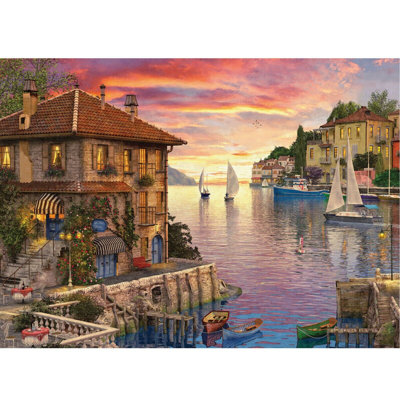
Beautifully finished and extremely high quality, this puzzle is sure to provide hours of fun for you and your family. With these beautiful scenic puzzles, you can enjoy hours of fun and feel a great sense of accomplishment once you’ve completed it. These puzzles are manufactured using high-quality printing methods to ensure the quality of the completed puzzle is just as beautiful as the original. Spend leisure hours with your family would be great. You can play it with your lovely family members or your friends. You can frame it and decorate your home after finish the puzzle, perfect home office wall decor.
Great jigsaw puzzle. Should keep us busy for a few days.. David S. Ireland. Tue Dec 24 2024

By METAL-TIME
A steam locomotive is a locomotive that provides the force to move itself and other vehicles by means of the expansion of steam. It is fuelled by burning combustible material (usually coal, oil or, rarely, wood) to heat water in the locomotive's boiler. nchanting world of trains comes to life with the Polar Steel SE Magic Express mini model DIY kit by Metal Time Workshop. Immerse yourself in the nostalgic era of steam locomotives, beautifully captured in this meticulously crafted steel model kit that offers both a trip down memory lane and a hands-on building experience. The Polar Steel SE Magic Express mini model DIY kit pays homage to the classic steam locomotive, a marvel of engineering that powered the railways of yesteryear. This miniature masterpiece is perfect for both seasoned model enthusiasts and those new to the world of DIY kits. Crafted by Metal Time Workshop, the kit features precision-cut steel components that ensure a seamless assembly process and a final product that radiates authenticity.