Use These Knives to Sharpen Your Culinary Skills
For every cutting technique, there's a perfect knife.
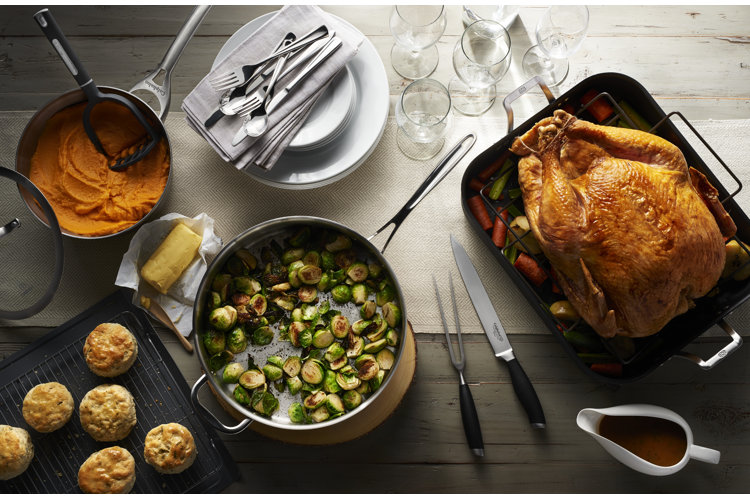
From preparing Sunday roasts to chopping vegetables, selecting the right type of knife for the job is a key ingredient for the perfect dish. Kitchen knife sets may look intimidating, but understanding the differences between knife types is easy. Asking yourself if you should to invest in a ceramic knife? Or perhaps a full stainless-steel knife set? Or maybe you're wondering how to use that knife sharpener? Our knife buying guide will help you decide which are the best kitchen knives for use at home.
The Most Popular Knife Types
Chef's Knives
Chef's knives are used for preparing vegetables, fish or meat. The slim shape of the blade causes less friction, making it a good choice if cooking predominantly with meat. With Chef's knives, you'll find that the average blade length is around 20cm.
Santoku Knives
Santoku knives are a great choice for preparing vegetables. The wide blade can be used as a palette for moving ingredients and its curve is perfect for dicing, as it';s easy to begin a rocking motion. A sharpening stone can be used to maintain the quality of this Japanese product long into the future.
Bread Knives
Like their name suggests, bread knives are the perfect choice for cutting bread with hard crusts due to their long, serrated edge. Bread knives can also come in handy when decorating cakes with icing or cream. The average blade length for a bread knife is around 20cm.
Paring Knives
Due to their weight and size, paring knives are suitable for chopping, cleaning and peeling fruit and vegetables. The average blade length is between 5 and 10cm
Popular Knife Blade Materials
In addition to choosing the right knife type, it’s also important to consider the different materials that can be used and their distinctive features.
Stainless Steel
The special composition of stainless steel blades keeps the knives rust resistant, stain resistant, corrosion resistant and chip resistant. Stainless steel knives will last a very long time with the proper care. Additionally, sharpening a stainless steel knife every now and again will keep the blade just as sharp as it would be if made from other materials and it will stay looking as new as the day you bought it.
Carbon Steel
More carbon in the knife's blade leads to a stronger, harder metal which stays sharper for longer. This allows you to make more precise cuts with less effort, making the knife safer as an added bonus.
The material is harder than stainless steel, although not quite as hard as ceramic. This means it needs much less maintenance and will hold its edge longer.
Ceramic
As ceramic is an extra-hard material, the blades have an exceptionally sharp edge. Additionally they can last ten times longer without sharpening as other materials. Ceramic kitchen knives do not rust or degrade from cutting acidic food, making them perfect for cutting fruit and vegetables. Ceramic knives are also very easy to wash and clean, being naturally non-stick.
Extra Tips & Complementary Pieces
Caring for Your Knives
Try to avoid using the dishwasher. All knives should be cleaned with hot water, soap and a non-abrasive scrubber, such as a sponge. Knives should never go in the dishwasher because the force and heat of the water jets can dull the blade and sometimes cause handles to warp.
Storing Knives
When your knives aren't being used, keep them safe on a magnetic board or in a knife block. This will help them remain sharp for as long as possible.
Chopping Boards
For chopping and cutting your food, chopping boards are an essential tool to prevent your kitchen units and worktops from developing scratches. Discover which chopping board is ideal for your kitchen with our cutting board guide.
Sharpening
Sharpening stones, sharpening steels or electric knife sharpeners are tools that will keep your knives from becoming dull. We know the use of sharpening stones can be tricky for beginners, read on for some handy tips.
How to Use a Knife Sharpening Stone
To start, each sharpening stone should be moistened with water. Some knife sharpener blocks should be fully submerged until no bubbles are seen, but this will be made clear by the manufacturer. Knife sharpeners with grain sizes up to 800 are ideal if you haven't sharpened your knife in a while, and grit sizes of around 1000 can then be used to refine the edge. To use the stone, the knife is pulled back and forth in a flowing motion at the appropriate angle. This should be done over the entire length of the blade, on both sides of the knife (except in the case of some Japanese knives). Once sharpened, the knife should be stored carefully in a knife block or rack to keep the edge.
When grinding the edge of a larger knife, it may be easier to refine the edge in three stages: at the tip, the middle, and the back. The best grinding angle is usually 15 degrees for European knives such as chef&'s knives and 10 degrees for Japanese knives like the Santoku knife.
Tip: You can use a spirit level app on your phone to quickly show you what these angles look like. Remember to keep the blade at the same angle while sharpening.
