The Best Types of Door Knobs & Door Locks for Your Home
Your complete guide to door hardware.
When it comes to door hardware, safety and know-how are key. Read our guide for a rundown on the best types of door locks and types of doorknobs available for your home. You won't have to sacrifice on style either.
Interior Locks & Knobs
Interior door hardware pertains to hardware for your interior doors; more specifically, interior door handles (including knobs and levers) and interior door locks. Choosing the best types of doorknobs and locks for your home depends on your privacy and style preferences.
Types of Door Knobs
We have different types of door knobs and door handles for every need.
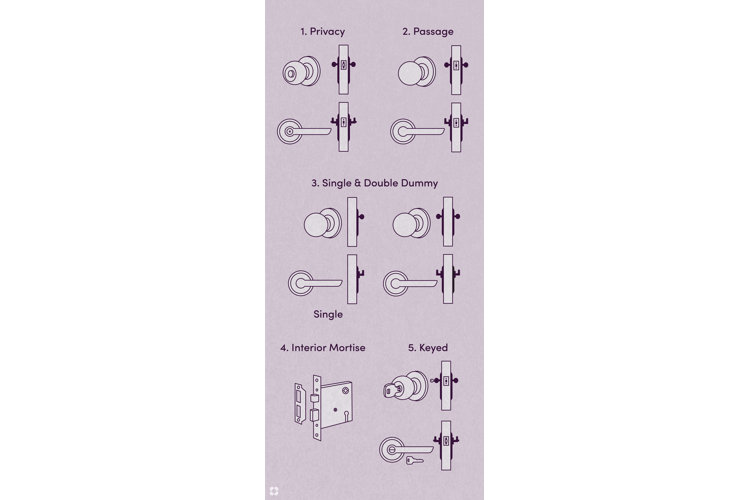
Privacy: Privacy hardware is lockable, which makes it the perfect choice for bedrooms, bathrooms and other spaces in which you'd like some assurance of privacy. Privacy hardware can come in the form of a traditional door knob or a door handle. The lock control mechanisms are located on the inside of the door. Most privacy locks are operated by pushing a button or turning a small knob – we'll delve deeper into the different types of door locks later on in this guide. To unlock the door from the inside, simply turn the door knob or return the small locking knob back to its original position. Most privacy hardware can also be unlocked from the outside by sticking a long, thin object into the lock release hole.
Passage: Passage door knobs and levers are some of the simplest pieces of door hardware available. Because they don't have any sort of locking mechanisms, these door handles allow for unhindered access from either side of the door. They're great for closets, cupboards, cabinets and other spaces that don't require privacy but could benefit from being closed off from time to time.
Single Dummy & Double Dummy: Dummy door handles mount to a door’s surface right where a standard door handle would go, but they don't have any mechanical functions – they're used as decorative pieces only. A single dummy refers to a single door knob or lever being present on one side of the door. A dummy pair (or double dummy) entails a matching set of two decorative knobs that can be installed together on either side of a single door or individually on opposing panels of French doors.
Interior Mortise: Interior mortise handles come with a large rectangular lock that sits inside the door rather than existing separately on the knob. These tend to be found in older homes. Most mortise handles resemble your standard door knobs or levers, but many older models have a very traditional look. They are typically paired with skeleton keys and are connected to a dead bolt. Interior mortise hardware locks more securely than modern privacy hardware does, however it is a bit more difficult to install.
Keyed: Because they require a key to lock and unlock, these door handles provide utmost privacy. That said, you have to take care not to lose the key or keys to your door or you might find yourself in a sticky situation.
Push: Push locks are some of the most basic interior door locks available. To activate a push lock, push the button in the centre of the door knob or handle until it clicks into place. All you have to do to unlock the door from the inside is turn the door knob or handle – the lock will automatically release. Most push-lock door hardware can be unlocked from the outside as well; simply insert a long, thin object into the small hole located on the outer knob or lever and push until you hear a click and feel a release.
Thumb Turn: Thumb-turn door locks are a bit more traditional in look and design than push locks. These door knobs and handles have a small turnable knob located at their centre. To lock the door from the inside, simply turn this central knob 90° counterclockwise or clockwise (the direction differs from handle to handle). To unlock, turn the central knob 90° in the opposite direction.
Trim: While push locks and thumb-turn locks are available for both door knobs and door handle, trim locks are only available for door knobs. These locks are not located on the door knob itself; instead, they appear on the trim around the door knob. Most trim locks are small buttons that can be pushed to lock the door. Like push door locks, trim locks can be released by turning the door knob. These locks are a good choice if you prefer your door knobs to have a smooth, sleek finish.
Exterior Locks & Knobs
Any door that leads outside requires a heavier duty handle and lock than an interior door. Learn more about exterior door locks and knobs – often packaged together as entry sets – by reading below.
Types of Entry Sets
Entry sets provide another layer of security by packaging heavy-duty door knobs or handles with a set of robust exterior locks.
Handleset: This is one of the most standard entry sets. Handleset exterior door hardware can include an interior-facing door knob and a corresponding exterior-facing handle, both with a built-in lock (usually a thumb-turn lock), as well as a separate dead bolt with an interior-facing control lever. The two separate locks ensure additional security by allowing you to lock your door in two separate places. These exterior door locks must be unlocked from the outside with a key. Handleset hardware is recommended for your front and main doors.
Knob Combo & Lever Combo Packs: In a knob-combo or lever-combo exterior door hardware pack, the dead bolt is attached to the knob or lever. By turning the lock on the knob or lever, you are locking the dead bolt. These locks are typically controlled by a thumb-turn mechanism on the inside and can only be unlocked from the outside with a key. These hardware packs are recommended for exterior doors that might not need two separate locks, such as a garage door.
One-Piece Knobset & One-Piece Leverset: If you like the look of your door handle and lock on the same trim piece, you’ll love one-piece entry sets. These sets include all the basics that handleset hardware sets do, but the doorknobs or handles are attached to the dead bolt mechanism instead of separate. Typically, these hardware sets will have the same door knob type on both sides of the door, usually knobs or handles.
Mortise Lockset: This entry set has a mortise lock system, an old locking mechanism that has fallen out of modern fashion and function. Because these lock systems require specific grooves or pockets to be cut into the door, we recommend only going with a mortise lockset if you are replacing an existing mortise lockset with a new one or are looking for an appropriate piece of hardware for an antique door. These entry sets do come with handles.
Exterior & Interior Packs: Exterior packs come with a lock and handle made specifically for the exterior side of your door. Interior packs include a lock and handle made specifically for the interior side of your door. Unlike handlesets that include both exterior and interior hardware, these packs are sold separately. In order to have a complete entry set, you’ll need to purchase both an exterior and interior pack. You may want to purchase these separately if you’d like a different style or finish for the outside and inside of your home. Before you buy, be sure to check that the exterior and interior packs you've chosen are compatible. Most interior and exterior door hardware is prepared for standard doors, but take care to look at each piece's bore-hole dimensions to be sure. Filter by Product Type to select an exterior or interior-specific entry set.
Types of Entry-Set Locks
Entry sets are guaranteed to come with a dead bolt, but it’s up to you how many you want in your lockset.
One-Point: A one-point entry set includes one lock that controls a dead bolt. One-point locks are typically operated on the inside by a small lever – simply turn it 90° clockwise or counterclockwise to lock and unlock the dead bolt. To lock and unlock a one-point exterior lock from the outside of the door, you'll need to insert and turn a key.
Two-Point: These exterior door locksets include two locks – one that corresponds to the dead bolt and another that locks the handle or knob itself. Typically, the interior locking mechanism for the dead bolt is a small lever and the interior locking mechanism for the knob or handle is a thumb-turn device. Externally, you'll need a key to lock and unlock both locks. Because of their two separate locking mechanisms, these exterior door locksets add an additional layer of protection to your home.
Types of Dead Bolts
Keep your home safe with a sturdy dead bolt.
Single-Cylinder: This dead bolt has one cylinder that requires unlocking from the outside. No key is required to unlock the door from the inside; just flip the bolt lever to open.
Double-Cylinder: These dead bolt locks are uncommon and should not be present on any door that might be used for evacuation, as they require a key to unlock them from both sides. This can present a safety hazard in an emergency situation. The same key can be used to lock and unlock the dead bolt from both sides of the door.
One-Sided: This dead bolt locks and unlocks from the inside. There is no opening the door from the outside if the lock has been bolted.
Types of Electronic Locks
Electronic locks are similar to your favourite door hardware but with a high-tech twist. Electronic locks are preferred over traditional exterior door locks because they don't require you to fish around for your keys before you can unlock your door – all you have to do is remember a code and type it into the hardware's built-in keypad. These locks are also a favourite of families with children, as parents don't need to worry about their kids being locked out of the house.
