Trampoline Buying Guide
Everything you need to know for buying and maintaining a trampoline.
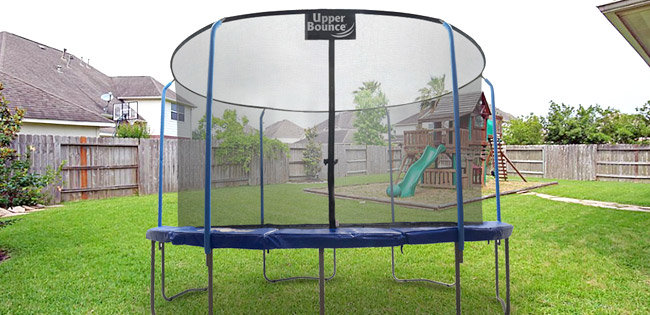
Upper Bounce 14-Foot Trampoline with Enclosure / Upper Bounce Two-Way Foldable 40-Inch Trampoline
Purchasing a Trampoline
Trampolines provide aerial fun (and excellent exercise!) for the entire family. If you're ready to jump to new heights, this guide contains everything you need to know about purchasing a trampoline, including assembly, safety, and maintenance.
Before You Buy
Before you decide on a trampoline, make sure you have adequate space.
- A minimum of 7,5m of overhead clearance is required.
- Horizontal clearance of 2m from objects like fences, bushes, and houses should be maintained around the trampoline, even with an enclosure installed.
- The trampoline should be placed on level ground, preferably grass. Hard surfaces add stress to the frame and cause damage over time.
- Never place objects under the trampoline.
Additional Considerations - Trampolines over 0,5m in height are not recommended for children under 6 years of age.
- The maximum recommended user weight for trampoline use is 150kg.
- Overloading the trampoline may cause damage to the structure.
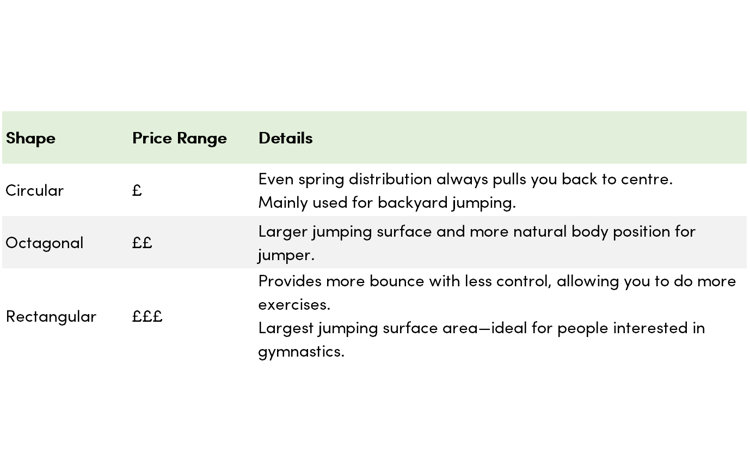
Trampoline Types
Trampoline Parts and Assembly
Trampoline assembly requires at least two capable adults. Never set up a trampoline in rainy or stormy conditions, especially if lightning is present. Before you begin, read all the assembly instructions carefully.
Common trampoline parts and accessories:
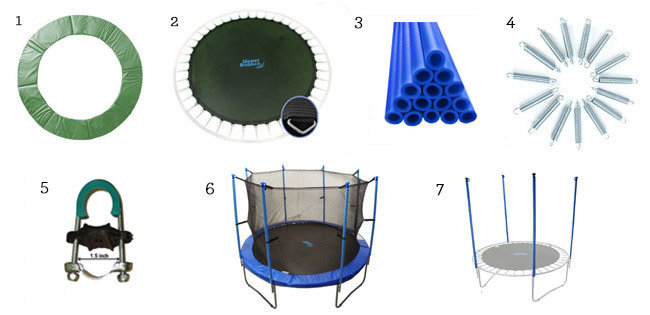
1) Frame Pad; 2. Jumping Surface; 3. Foam Sleeves; 4. and 5. Springs and Hardware; 6. and 7. Enclosure Net and Poles.
*All trampoline parts are subject to variation and compatibility based on model and type purchased.
There are three types of trampoline support structures.
- Poles: The more poles a trampoline has, the greater the stability it will have.
- Arches: Link poles together for added strength.
- Fibreglass: With a ring on top, this structure ties all the poles together for a clean look.
Frame Paint
Since trampolines are exposed to the elements, look for a frame coated in rust- and corrosion-preventing paint.
Tip!
For additional safety and care, consider a mesh enclosure ring and trampoline cover. A mesh ring wraps around the trampoline for added safety and security. A trampoline cover protects the trampoline from rain, UV sun rays, and other weather damage.
Purchasing Replacement Parts
Trampoline parts should be replaced as they age—see the instructions and manufacturers' specifications for the common lifetime of your equipment. Keeping the trampoline in the shade or using a cover will prevent sun and weather damage. Watch for rusting parts, malfunctioning springs and worn fabrics with every use.
- Enclosure net, enclosure poles, enclosure pole cap*
- Protective foam pole sleeve
- Jumping mat*
- Trampoline pad*
- Anchor kit
- Weather cover*
- Trampoline ladder
- Springs, spring tool
- Shoe bag
*Denotes products that are shape-and-size specific
If you need to order replacement parts, measure carefully to order the right size and type.
• Frame size: Measure from edge to edge, horizontal and vertical. This is the most important part to measure, as all parts attach to the frame and are related to the frame size.
• Jumping Mat: Measure the frame, spring size, and quantity of springs.
• Spring: Measure the spring size from edge to edge.
• Enclosure Net: The type of net depends on the type and amount of poles your trampoline has.
• Enclosure Set: Consider how many footing legs your trampoline has.
• Caps/Sleeves: Check the diameter and length of your poles and the type of pole caps.
• Weather Cover: A cover offers years of protection from the elements. Covers come in a variety of sizes, so check the exact measurements of your trampoline before ordering.
Safety Guidelines
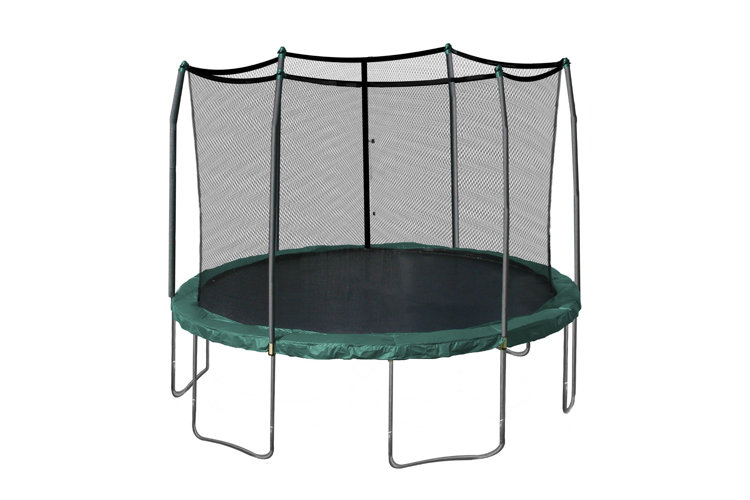
Follow these essential safety tips when using your trampoline:
- Make sure your trampoline is installed with adequate space around the perimeter before you start jumping.
- Allow only one jumper at a time. Multiple users increase the risk of collision.
- Jumpers should always be supervised, regardless of age or experience of the user.
- Jump in bare feet. Shoes will damage the mat and socks increase the chance of injury.
- Never jump on a wet trampoline.
- Use the trampoline only in appropriate weather conditions.
