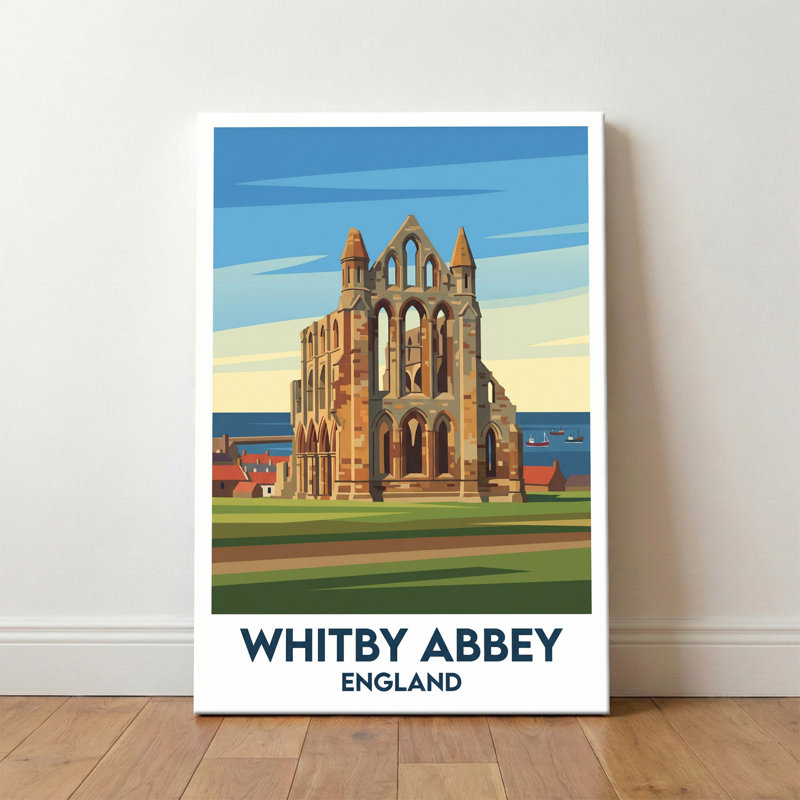
Perched above Whitby's bustling harbour, the ruined silhouette of Whitby Abbey has long been a beacon for travellers, storytellers and those who favour a hint of melancholy in their view of the sea. This travel poster celebrates that timeless drama: the abbey's soaring arches and ruined tracery rendered in clean lines and a pared-back palette that recalls the golden hour on the Yorkshire coast.
Whitby's abbey began as a place of prayer and learning. Founded in the 7th century and later rebuilt into a great Benedictine house, its stones have seen centuries of pilgrim feet, Viking raids and the slow work of the North Sea wind. The Dissolution of the Monasteries left the abbey roofless, but its grandeur remained - a ruin that frames the sky and sea, as central to Whitby's identity today as the narrow streets below.
The town itself is a mixture of fishermen's cottages, cobbled lanes and maritime industry, all gathered at the foot of the East Cliff. Climb the 199 steps from the harbour and the view opens: the red roofs of the town, the harbour lights, fishing boats at anchor and the endless wash of blue. That ascent has a novel quality - the very climb that inspired Bram Stoker when he set part of Dracula here - and the poster taps into that literary romance without declaring it, leaving room for quiet imagining.
In this image the abbey is presented as both monument and invitation. The composition uses broad planes of colour and light to emphasise the building's Gothic rhythm: stacked arches, lancet windows and crenellated towers. Warm ochres and sunlit sandstone contrast with cool sea-blues and the deep greens of cliff-top grass. The sky is a study in calm, with long, horizontal bands suggesting a salty breeze and the slow movement of passing clouds.


 18+, T&C apply, Credit subject to status.Learn more