Stainless Steel Decorative Game
By METAL-TIME
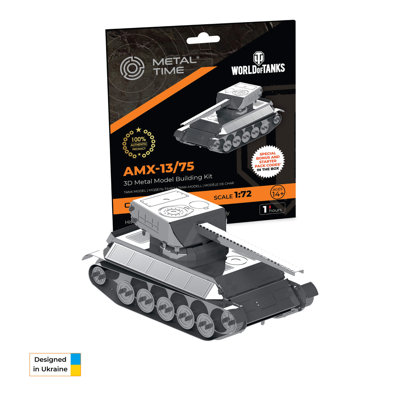
Maneuverable light tank with an oscillating turret and a 75 mm autoloader gun that could fire up to 10 shots per minute. At that time, the gun on this vehicle had superior penetration compared to the guns of most other medium tanks. The tank has a decent top-end gun and good dynamic performance. In the last years of World War II strategists and manufacturers of military equipment began to think about new generations of weapons. And one of the successful embodiments of the new concepts of armored fighting vehicles was the French light tank "AMX-13". Its first prototypes appeared in 1945 and its subsequent modifications were used in military operations until the XXI century. This maneuverable tank with a length of 5 meters and a height of 2.4 m originally possessed several unique design features. The most important of these was the "rocking" turret. The main design principle was that after the gun had fired, returning impulse was delivered to the turret and caused a new shell to move to the breech block of the gun and the loader mechanism to push it inside the barrel. This allowed automatic firing at a rate of up to 12 rounds per minute! Considering that such tanks were equipped with a 75-mm gun, this turned the tank into a vehicle for the continuous destruction of everything in the line of fire. Further modifications of the "AMX-13" were equipped with 100-mm and even 155-mm guns. In such a form it could compete with medium tanks and mobile guns. However, another difference of this tank was its speed. It could reach up to 60km/h on a hard surface (up to 400km), get over obstacles up to 60cm high, ditches up to 1.5m deep, and water obstacles up to 0.8m deep. Along with the brilliant characteristics, "AMX-13" also had disadvantages. It had weak armor, which was typical of light tanks, and the downside of rapid fire - the need to replenish ammunition. When the shells ran out in combat, the tank became unarmed and was often doomed to destruction.
Stainless Steel Decorative Game
By METAL-TIME
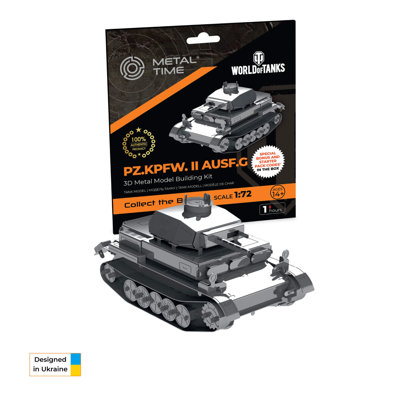
On June 18, 1938, MAN and Daimler-Benz received an order for an initial batch of 75 Pz II Ausf. G tanks. A prototype was manufactured in 1939. The vehicle was produced from April 1941 through February 1942, with a total of only 12 tanks built. World War II brought armored vehicles to the forefront, making them the main striking force. But it all began not with heavy, unstoppable, powerful machines with siege weapons, but with small maneuverable tanks. One of the remarkable examples of engineering creativity of the 1940s is the German "Panzer II Ausf G". A chain of modifications to the basic model, which was one of the most numerous tanks until 1942, led to its appearance. The "Panzer II Ausf G" significantly increased in speed. Unlike its rather slow predecessor, it could reach speeds of up to 50 km/h on the highway, which improves its mobility. Due to its good maneuverability, this light tank could perform tasks of escorting and providing fire cover for infantry even better. Its armor was sufficient to protect against small arms and mines, but artillery strikes became fatal for the Panzer II. The main weapon of the "Panzer II Ausf G" remained the 20mm automatic cannon and the 7.92mm MG-34 machine gun. The main protection was the turret design with ricochet angles, which allowed to soften or deflect enemy shell hits. The “Panzer II Ausf G” crew consisted of three people. Unlike the previous model, the driver and radio operator received viewports in the front and sides of the hull, improving the combat vehicle's maneuverability.
Stainless Steel Decorative Game
By METAL-TIME
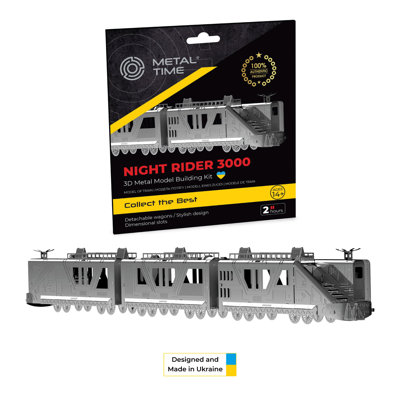
The Night Rider train is an imaginary train set in a fictional post-apocalyptic future. It crosses the desert only at night due to the impossibility of movement during the day due to the high air temperature. The Night Rider is a fully armored train often used to transport valuable passengers and cargo. Explore the thrilling world of the Night Rider 3000 DIY model kit, a captivating representation of an imaginary train set in a fictional post-apocalyptic future. This meticulously crafted steel model captures the essence of an armored train that braves the desert only under the cover of darkness, navigating the unforgiving landscape where daytime temperatures soar to extremes. The Night Rider 3000 is not just a model; it's a journey into a dystopian world where creativity knows no bounds. This DIY kit allows enthusiasts of all ages to bring the mystique of this fully armored train to life with their own hands. Each piece is precision-cut from high-quality steel, ensuring a satisfying building experience and a durable final product that can stand the test of time.
Stainless Steel Decorative Game
By METAL-TIME
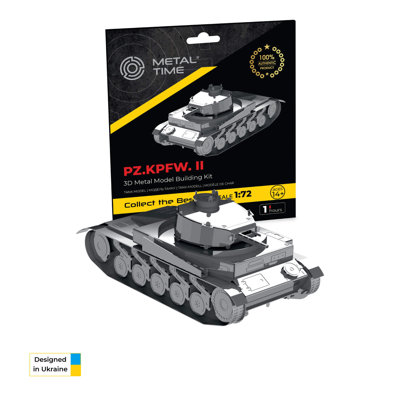
The last modification of the light Pz. II tank. The vehicle featured enhanced armor, the 2 cm KwK 38 gun and improved observation devices. A total of 524 vehicles were built from March 1941 through December 1942. This may sound strange, but the iron mechanical power of the Wehrmacht in World War II began with... a tractor. It was under the name "agricultural tractor LaS 100" that Germany produced the first combat tanks of the largest war of the 20th century. The modification of the basic model Panzer I became the light tank “Panzerkampfwagen II” or “Pz.Kpfw. II”. It was one of the most mass-produced combat vehicles of World War II. By 1942, when they gave way to heavy machines, more than 3,500 of them had been produced. This not-fast tank, weighing about 8 tons, could reach a speed of 40 km/h on the highway and was designed to cover infantry attacks. Its armor was sufficient to protect against small arms and mines, but artillery strikes were fatal to the Panzer II. Moreover, its firepower was hardly impressive. The main weapon of the tank was a 20mm automatic cannon. There were several weapons options - tank modifications with flamethrower systems and heavy machine guns as the main weapon exist. The main protection was the turret design with ricochet angles, which allowed for the softening or reflecting of enemy weapons hits.
Stainless Steel Decorative Game
By METAL-TIME
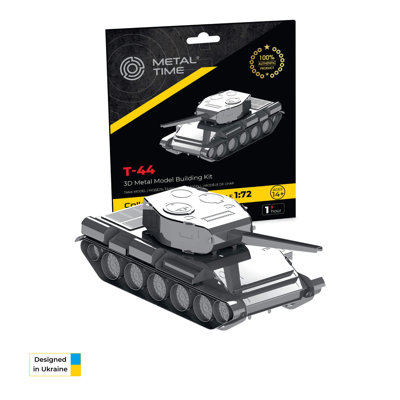
After the cancellation of the T-43, a replacement for the T-34 was still desired and work began on the T-44 in late 1943. Three prototypes were produced, with a 122 mm armed design being rejected. The 85 mm variant was accepted for production, which commenced in 1944 and the tank remained in service until the 1970s. The medium tank “T-44” could have become the best tank of World War II, but it never fired a shot on the battlefield. This combat vehicle was created in 1943 but never came into the front lines. In the last years of the war, the Soviet command realized that despite their quantity and decent mobility and reliability, the “T-34” tanks, even with the 85mm gun modification, were inferior to the best German armored vehicles - the “Tiger II” and “Panther” tanks. In head-to-head battles, the Soviet tanks had no chance due to their weak armor protection. Therefore, it was decided to create a tank with similar mobility and long-range capabilities as the “T-34”, but with significantly reinforced frontal armor. Thus, the “T-44” was born. It underwent significant modifications. The decision was made to abandon the Christie suspension, and increase the power of the gun while maintaining the advantages of a medium "cruiser" tank. The result was a powerful, fast, and well-protected combat vehicle capable of combining the armor protection of a heavy tank with the mobility of a medium one. Modifications were released with 100 mm and even 122 mm caliber guns, but due to the vehicle's weight increase, they had to be abandoned in favor of the 85 mm gun created based on the rapid-fire D5-T gun. Despite its worthy characteristics, the “T-44” was not put into mass production until the end of World War II, so as not to disrupt the production cycle of the “T-34-85”, which had similar parameters. However, after the war, the tank was produced in large batches and remained in service with the Soviet army until the 1970s.
Stainless Steel Decorative Game
By METAL-TIME
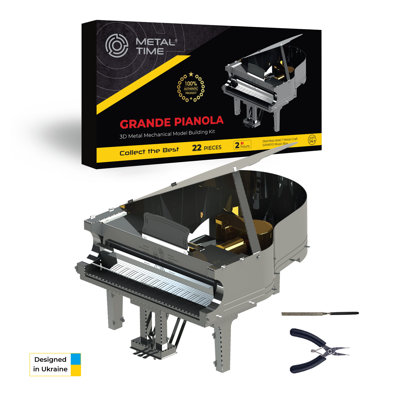
Throughout mankind's existence, music has been the primary means for expressing emotions, building a psycho-emotional state both at individual and group levels. Initially, music creation was based on vibrating natural materials. While stationary objects were used for extracting rhythmic sounds, tonal sounds were extracted from string-like vibrations. The development took the human, technical thought millenniums before we could hear music in all its splendour. IT was up to until when Bartolomeo Cristoforo invented the piano in the 18th century in Italy that musical instruments attained their true beauty and complexity. This complicated keyboard-string mechanism has produced the finest musical masterpieces in mankind's history. "Royal" in translation implies "royal". This is the actual king with regards to musical instruments, the peak of mankind's technical genius.