Show Related CategoriesCategory
to:
Figurines & Sculptures
Decorative Book
Vase Filler
Statue
Money Box
Bust
Hourglass
Cloches & Water Globes
Crystal
Farmhouse Inspired
Glam Accents
Beach, Coastal & Nautical
Boho Chic
Cool Colored Industrial
Modern Accents
13 Items

By METAL-TIME
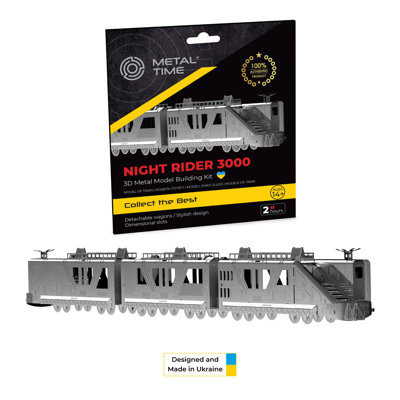
The Night Rider train is an imaginary train set in a fictional post-apocalyptic future. It crosses the desert only at night due to the impossibility of movement during the day due to the high air temperature. The Night Rider is a fully armored train often used to transport valuable passengers and cargo. Explore the thrilling world of the Night Rider 3000 DIY model kit, a captivating representation of an imaginary train set in a fictional post-apocalyptic future. This meticulously crafted steel model captures the essence of an armored train that braves the desert only under the cover of darkness, navigating the unforgiving landscape where daytime temperatures soar to extremes. The Night Rider 3000 is not just a model; it's a journey into a dystopian world where creativity knows no bounds. This DIY kit allows enthusiasts of all ages to bring the mystique of this fully armored train to life with their own hands. Each piece is precision-cut from high-quality steel, ensuring a satisfying building experience and a durable final product that can stand the test of time.

By METAL-TIME
Free Delivery
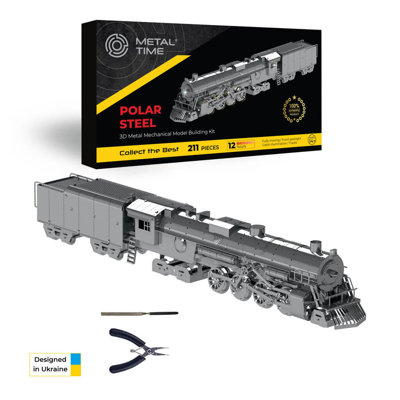
The train is waiting for you. "Polar Steel" is journeying to the North Pole. Boards the train and race north over mountains and through boreal forests inhabited by timber wolves as well as rabbits, but this train never slows down. Build "Polar Steel" train with your own hands! At the very late hour of the night before Christmas, when even the most children fall asleep, and only the whistling of a blizzard is heard outside the window, a bright beam of a spotlight suddenly cuts through the snowy haze and it appears in clouds of smoke and steam. Try not to fall asleep, and you will definitely get into his car. This train will take you to the North Pole, where Santa Claus himself collects gifts. Neither high mountains, nor endless snow-covered fields, nor an impenetrable forest will stop the train, and it will definitely arrive on time. Yes, this is the Polar Express from the animation of Robert Zemeckis - an attentive viewer will exclaim. And it is true. It was this cult film that inspired the designers of Metal Time, creating the Polar Steel model. The railway is a huge fascinating world for romantics who dream of traveling, fans of the history of the development of technology and design lovers, because every step in the development of railways is associated with millions of original technical solutions. Therefore, the model of the railway is the eternal dream of the overwhelming number of children and adolescents. Every aspect of railway technology is of interest: tracks, wagons, locomotives and buildings. Someone likes electric locomotives, and someone is still passionate about steam technology. And indeed, the locomotives from the fire-breathing dragons of the childhood of those over 50 have turned into relic samples, of which there are very few left in the real world. Therefore, the embodiment of steam locomotives in the form of self-propelled models is a successful way to win the hearts of tinkerers. Engineers, constructors and designers of "Metal Time" tried and created a new designer for self-assembly called "Polar Steel". This is a model of a ten-axle steam locomotive with a closed tender. Thanks to the use of colored stainless steel, the model has acquired unique color accents. Tender, cab. Tanks and wheel faces received a matte blue color. The shell of the cauldron has become a dull dark grey. Pipes and fittings, the boiler cover, as well as the details of the lantern are highlighted in matt yellow. As a result, the aesthetics of the steam locomotive has completely changed, and it is no longer associated with black coal, fuel oil and smoke - a real fabulous express train. A sense of wonder is also created by sound and light effects. Yes, the Polar Steel model is equipped not only with an LED lamp, but also with a sound chip capable of making sounds characteristic of a moving steam engine and its horn. Add to that the rails and freewheeling wheels and here is another locomotive for the Metal Time railway hub. The perfect gift for any tech lover!

By METAL-TIME
Developed for trench warfare. Initially, the armament was to be placed in the front part of the hull and side sponsons. However, later it was decided not to add sponsons but to mount a turret. By 1943, when the TOG 2* was completed and ready for trials, it was already obsolete. The vehicle never entered service. Before World War II, the British military was concerned with building a fleet of new tanks. It was to be headed by a new super-heavy tank for storming enemy positions. The British had experience in building such vehicles since World War I. They were clumsy huge moving fortresses with powerful armor and armament. Therefore, the object called "TOG II" also had these qualities. The armored monster with a weight of 82 tons, a height of 3 m, and a length of more than 10 m had to strike fear into the enemy. Like its predecessors, the running gear of the tank was concealed inside the hull, and the tracks protruded from the central part, which was an armored capsule for weapons and a crew of six. At first, the designers had an idea to hang the armament also on the sponsons, but then it was moved to the front of the tank and the sponsons became part of the main body. Hatches were made in them for the ejection of shells and loading of ammunition. The main gun of the “TOG II” was a 75mm “QF 17 pounder” anti-tank gun, the best in its class in service in Great Britain. In addition to this, the front of the tank had a slot for a 7.92mm "BESA" machine gun. "The TOG II” was propelled by a 600 hp “Paxman-Ricardo” engine. The speed of the tank was not high, but its purpose was not to make a rapid assault but to destroy trenches and fortifications of the enemy and destroy tanks and manpower of the enemy. The role of the tank as a mobile gun was also considered, but later this idea was rejected.

By METAL-TIME
Free Delivery
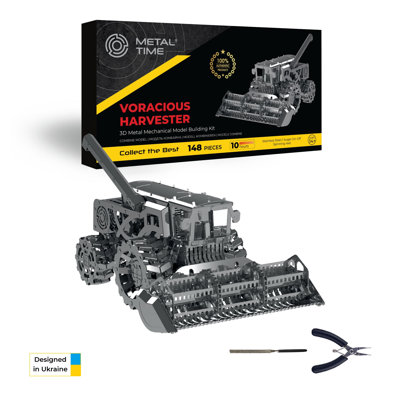
In 1826 in Scotland, the inventor Reverend Patrick Bell designed a reaper machine, which used the scissors principle of plant cutting; a principle that is still used today. The Bell machine was pushed by horses. A few Bell machines were available in the United States. In 1835, in the United States, Hiram Moore built and patented the first combine harvester, which was capable of reaping, threshing and winnowing cereal grain. Blue skies, endless fields, and hundreds of workers are harvesting. Peace and prosperity. Such idyllic paintings are symbols of prosperity in the cultures of many countries. However, technological progress makes its own adjustments to the established ideas. Now millions of agricultural workers have been replaced by machines. Their diversity is very great. They can sow, nurture, fertilize, irrigate, protect, and eventually harvest almost all crops. All these machines are united by one broad term - "combines". Of these, the most impressive mechanism is the combine harvester. One such machine can replace a thousand people on the field. Knowing no fatigue, the harvester cuts threshes the ears, separates the straw from the grain, forms sheaves, and unloads the final product. And it doesn't stop moving. There are harvesters capable of very complex operations with different types of crops. One thing unites them: these machines serve to save humanity from hunger. Therefore, the Metal Time team could not help but pay tribute to these wonderful mechanisms. "Voracious Harvester" is a DIY model of a combine harvester. A standard model of a cereal harvesting machine was taken as a prototype. The main parts that determine the appearance of the combine are the header and the bunker. The cutting blades and rotating reel are clearly marked on the header. The further processing process is hidden by the case, inside which the winding spring mechanism and the gear system are located. In front of the hull, there is a cab, in which there are schematically marked combine harvester controls - a steering wheel and a dashboard. The main part of the body is a hopper with a swivel unloading auger tube that pivots around the near end and can be extended sideways to simulate grain unloading.

By METAL-TIME
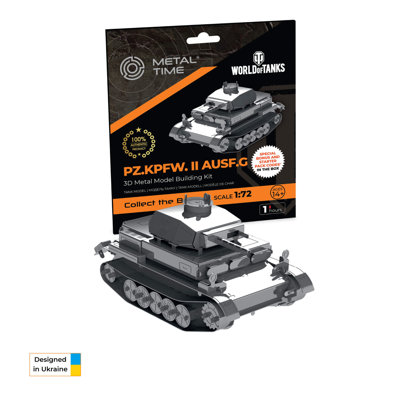
On June 18, 1938, MAN and Daimler-Benz received an order for an initial batch of 75 Pz II Ausf. G tanks. A prototype was manufactured in 1939. The vehicle was produced from April 1941 through February 1942, with a total of only 12 tanks built. World War II brought armored vehicles to the forefront, making them the main striking force. But it all began not with heavy, unstoppable, powerful machines with siege weapons, but with small maneuverable tanks. One of the remarkable examples of engineering creativity of the 1940s is the German "Panzer II Ausf G". A chain of modifications to the basic model, which was one of the most numerous tanks until 1942, led to its appearance. The "Panzer II Ausf G" significantly increased in speed. Unlike its rather slow predecessor, it could reach speeds of up to 50 km/h on the highway, which improves its mobility. Due to its good maneuverability, this light tank could perform tasks of escorting and providing fire cover for infantry even better. Its armor was sufficient to protect against small arms and mines, but artillery strikes became fatal for the Panzer II. The main weapon of the "Panzer II Ausf G" remained the 20mm automatic cannon and the 7.92mm MG-34 machine gun. The main protection was the turret design with ricochet angles, which allowed to soften or deflect enemy shell hits. The “Panzer II Ausf G” crew consisted of three people. Unlike the previous model, the driver and radio operator received viewports in the front and sides of the hull, improving the combat vehicle's maneuverability.

By METAL-TIME
Development started in the spring of 1942. After undergoing trials, the decision was made to replace the 57 mm gun with a 75 mm gun. The vehicle passed trials in the fall of 1942, but never saw service. The prefabricated scale model of the "Object 430" tank can be used as a souvenir, as interior decoration, and as a valuable prize for the fans of “WoT”. Also, it helps you to create installations, models, or reconstructions of tank battles of World War II. It will take a worthy place at the stand with the "Metal Time Workshop" and "World of tanks" collection of DIY models. But its main purpose – is technical creativity, joint modeling, development of handmade skills. Metal Time" assembly models encourage their owners to study the history of engineering and to develop skills in construction. Each of our models is assigned a unique serial number and it turns them into a subject of collection and exchange. The "Metal Time" Owners Club is a growing community of enthusiastic builders. The idea behind such vehicles was the high mobility of these "traveling guns" and the rapid deployment of firing points or batteries based on them. In tests the "T67" performed well and in 1942 it was accepted as a new basic model of “tank killers”. However, its combat life never took place. After modifications of transmission and platform "T67" was turned into another machine, which became a prototype for the legendary "M18 Hellcat". The failed "tank killer" "T67" had classic tank architecture and accommodated a crew of five. Despite its short life, this project was a milestone in the development of armored fighting vehicles and thus earned the attention and respect of all fans of construction and engineering history.

By METAL-TIME
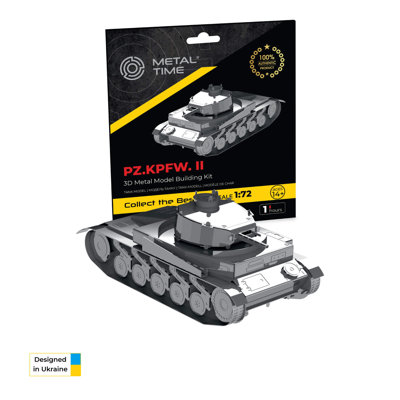
The last modification of the light Pz. II tank. The vehicle featured enhanced armor, the 2 cm KwK 38 gun and improved observation devices. A total of 524 vehicles were built from March 1941 through December 1942. This may sound strange, but the iron mechanical power of the Wehrmacht in World War II began with... a tractor. It was under the name "agricultural tractor LaS 100" that Germany produced the first combat tanks of the largest war of the 20th century. The modification of the basic model Panzer I became the light tank “Panzerkampfwagen II” or “Pz.Kpfw. II”. It was one of the most mass-produced combat vehicles of World War II. By 1942, when they gave way to heavy machines, more than 3,500 of them had been produced. This not-fast tank, weighing about 8 tons, could reach a speed of 40 km/h on the highway and was designed to cover infantry attacks. Its armor was sufficient to protect against small arms and mines, but artillery strikes were fatal to the Panzer II. Moreover, its firepower was hardly impressive. The main weapon of the tank was a 20mm automatic cannon. There were several weapons options - tank modifications with flamethrower systems and heavy machine guns as the main weapon exist. The main protection was the turret design with ricochet angles, which allowed for the softening or reflecting of enemy weapons hits.

By METAL-TIME
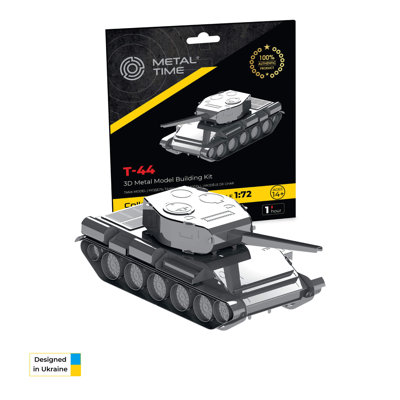
After the cancellation of the T-43, a replacement for the T-34 was still desired and work began on the T-44 in late 1943. Three prototypes were produced, with a 122 mm armed design being rejected. The 85 mm variant was accepted for production, which commenced in 1944 and the tank remained in service until the 1970s. The medium tank “T-44” could have become the best tank of World War II, but it never fired a shot on the battlefield. This combat vehicle was created in 1943 but never came into the front lines. In the last years of the war, the Soviet command realized that despite their quantity and decent mobility and reliability, the “T-34” tanks, even with the 85mm gun modification, were inferior to the best German armored vehicles - the “Tiger II” and “Panther” tanks. In head-to-head battles, the Soviet tanks had no chance due to their weak armor protection. Therefore, it was decided to create a tank with similar mobility and long-range capabilities as the “T-34”, but with significantly reinforced frontal armor. Thus, the “T-44” was born. It underwent significant modifications. The decision was made to abandon the Christie suspension, and increase the power of the gun while maintaining the advantages of a medium "cruiser" tank. The result was a powerful, fast, and well-protected combat vehicle capable of combining the armor protection of a heavy tank with the mobility of a medium one. Modifications were released with 100 mm and even 122 mm caliber guns, but due to the vehicle's weight increase, they had to be abandoned in favor of the 85 mm gun created based on the rapid-fire D5-T gun. Despite its worthy characteristics, the “T-44” was not put into mass production until the end of World War II, so as not to disrupt the production cycle of the “T-34-85”, which had similar parameters. However, after the war, the tank was produced in large batches and remained in service with the Soviet army until the 1970s.

By METAL-TIME
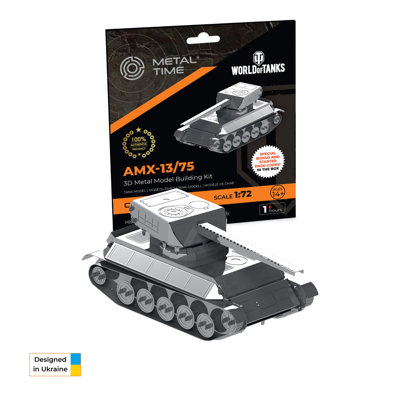
Maneuverable light tank with an oscillating turret and a 75 mm autoloader gun that could fire up to 10 shots per minute. At that time, the gun on this vehicle had superior penetration compared to the guns of most other medium tanks. The tank has a decent top-end gun and good dynamic performance. In the last years of World War II strategists and manufacturers of military equipment began to think about new generations of weapons. And one of the successful embodiments of the new concepts of armored fighting vehicles was the French light tank "AMX-13". Its first prototypes appeared in 1945 and its subsequent modifications were used in military operations until the XXI century. This maneuverable tank with a length of 5 meters and a height of 2.4 m originally possessed several unique design features. The most important of these was the "rocking" turret. The main design principle was that after the gun had fired, returning impulse was delivered to the turret and caused a new shell to move to the breech block of the gun and the loader mechanism to push it inside the barrel. This allowed automatic firing at a rate of up to 12 rounds per minute! Considering that such tanks were equipped with a 75-mm gun, this turned the tank into a vehicle for the continuous destruction of everything in the line of fire. Further modifications of the "AMX-13" were equipped with 100-mm and even 155-mm guns. In such a form it could compete with medium tanks and mobile guns. However, another difference of this tank was its speed. It could reach up to 60km/h on a hard surface (up to 400km), get over obstacles up to 60cm high, ditches up to 1.5m deep, and water obstacles up to 0.8m deep. Along with the brilliant characteristics, "AMX-13" also had disadvantages. It had weak armor, which was typical of light tanks, and the downside of rapid fire - the need to replenish ammunition. When the shells ran out in combat, the tank became unarmed and was often doomed to destruction.
By METAL-TIME
Free Delivery
Obstacles do not block the path, they are the path! All-terrain vehicles designed for rough and soggy terrain. The key feature of this ATV is the large wheels with an onboard system to inflate or deflate them, which allows vehicles to travel through water, cross brushwood, scramble and climb up thin ice. This technology helps customers to overcome obstacles, to solve their pains, to value trust and collaboration. Many secrets of the planet would not have been discovered if people had not invented cars that could drive along the most difficult route. There are no obstacles for all-terrain vehicles since obstacles are their usual road. Powerful engine, large low-pressure wheels, independent suspension, sealed windows and doors - and you are ready to search for treasures where no man has gone before. ATVs have gone through many transformations, and now engineers are inventing more and more new configurations - from amphibians to rovers. Therefore, all-terrain vehicles are an eternal source of inspiration for technical creativity. The designers of ‘’Metal Time’’ took the Ukrainian ‘’SHERP’’ all-terrain vehicle with ultra-low-pressure wheels as the basis for the ‘’Trophy Hunter’’ self-assembly model. Such machines have long been working in remote areas of the planet. But the creators could not resist the temptation to give the model futuristic features, thanks to which it became like a character in a science fiction film about the conquest of other planets. Space opera lovers will love it.

By METAL-TIME
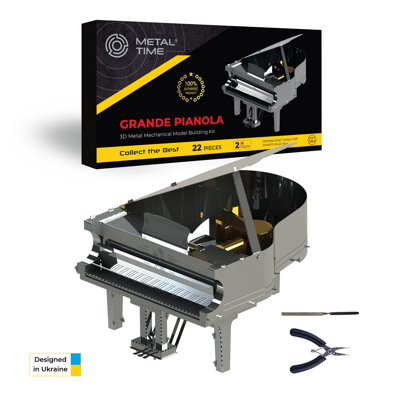
Throughout mankind's existence, music has been the primary means for expressing emotions, building a psycho-emotional state both at individual and group levels. Initially, music creation was based on vibrating natural materials. While stationary objects were used for extracting rhythmic sounds, tonal sounds were extracted from string-like vibrations. The development took the human, technical thought millenniums before we could hear music in all its splendour. IT was up to until when Bartolomeo Cristoforo invented the piano in the 18th century in Italy that musical instruments attained their true beauty and complexity. This complicated keyboard-string mechanism has produced the finest musical masterpieces in mankind's history. "Royal" in translation implies "royal". This is the actual king with regards to musical instruments, the peak of mankind's technical genius.

By METAL-TIME
Free Delivery
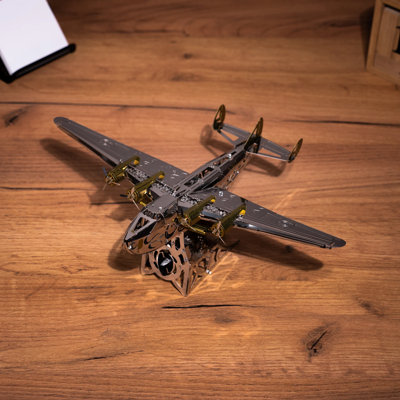
The flights across the Atlantic were a feat for pilots and passengers, although they occurred quite often and regularly in the first half of the 20th century. The journey often lasted most of the day, the machinery was not credible, and the weather conditions created stress every minute. And suddenly a plane appeared, capable of providing unprecedented comfort and safety to passengers. Even in the case of an unforeseen landing over the ocean, it guaranteed the survival of everyone on board. The secret is that it was a Boeing 314 Yankee Clipper floatplane. It was like one of the floors of a luxury hotel. Pull-out chairs, a restaurant porcelain tableware, and silverware, top-notch service. It was such a plane where James Bond could order his favorite cocktail without getting up and drink it from a crystal glass. The design of the hydroplane and the reserves of resources allowed it to stay in the air for up to a day without refueling and, in case of malfunctions, land on the water and continue its way as a huge boat. World War II changed the functionality of these aircraft and the luxury of air travel became a thing of the past. Paying tribute to this creation of American engineers, the Metal Time team created the Splashing Dreamer self-assembly kit based on the design of this glorious hydroplane.

By METAL-TIME
Free Delivery
For tens of thousands of years, human beings have been fascinated by the patterns of stars in the sky. Early people noticed constellations of stars that looked like animals and people, and made up stories about what they thought they saw. In fact, the oldest records we have of astronomical observations are 30,000-year-old paintings found on the walls of caves. Stars since ancient times are discribed as forever, hope, destiny, heaven and freedom. They have also for us people great importance and we believe that falling stars make our wishes. A new era in human history began on October 4, 1957. Her birth was bright and loud - among the fire, pillars of smoke and a deafening roar, the R-7 space rocket rose into the sky for the first time in history. A metal spear penetrated the layers of the atmosphere, and brought into orbit the first man-made object - Sputnik-1 Over the next 60 years, people got used to starts. Now, almost every week, rockets take off into the sky - metal cigars. Carrying a payload into near space. Many of them return back to Earth to repeat flights again and again. Despite more than half a century of history, the design and design of space rockets have not changed much. And it was they who inspired the designers of "Metal Time", creating a constructor for self-assembly "AD ASTRA". So far, rockets have only reached close space. This is their task - to overcome the resistance of the Earth's atmosphere and send their cargo to sail through space. However, along with the name "AD ASTRA", the developers of "Metal Time" gave the model the features of spaceships from the works of science fiction writers of the last century, implying that interstellar travel would be carried out by spaceships of this kind. The trend of 2022 in Metal Time models is the use of colored stainless steel. Therefore, "AD ASTRA" has acquired a variety of colors. The two stages of the rocket are cyan blue. And the stylized flames escaping from the engine nozzle are in red. Details are attached to the body, depicting "fins" - stabilizers, and air flows that the rocket cuts through in flight. The middle part of the case has a characteristic stainless steel mirror surface, in which a space-themed ornament is carved, which is reminiscent of illustrations from science fiction novels. But most importantly, the “AD ASTRA” model, assembled by skillful hands, comes to life thanks to the built-in light source and the ability to rotate. Light breaks through the stars carved into the case and leaves reflections on the walls and ceiling of the room. Turning the model into a night light, and the ceiling into a small planetarium. Fans of science fiction, space series and romance, dreaming of distant worlds, will be happy with the AD ASTRA constructor, and collectors of Metal Time models will add another outstanding exhibit to their collections.