What to Consider When Buying LED Lighting
The modern way to light up your home.

Energy saving, versatile and good for the environment, LED light bulbs have been hailed as the future for home lighting. As traditional light bulbs are being legally phased out across the EU, LED (light-emitting diode) lights are gaining popularity thanks to their many advantages. Read on to find out why LED light bulbs are ideal for your home.
Benefits of LED Light Bulbs
- Energy-efficient, using 90% less energy than traditional incandescent bulbs
- LED lights instantly shine bright once switched on
- They last much longer than your average lighting option
Additionally, modern LEDs are resistant to temperature fluctuations and extremes like heat in the summer or freezing cold in winter. This means there's now a wide range of LEDs for outdoor use.
The initial cost is higher for LED bulbs but your return on investment is roughly 6-12 months dependant on how much you use it - after that, you're saving money! LED costs on average 14 pence per KWH while a normal bulb uses 10 times more energy per KWH than an LED one.
Modern LED lighting is much more power-saving and flexible compared to conventional light sources. You can also choose exactly the type of light you want, from homely warm white to neutral white or even daylight white. We'll show you exactly what to look for and make it easy to buy LED lights with this guide.
Energy efficiency: Across the EU, light bulbs are divided by light output per power consumption. LED lamps are in the top energy efficiency classes; either A++, A + or A.
Brightness & Light Intensity
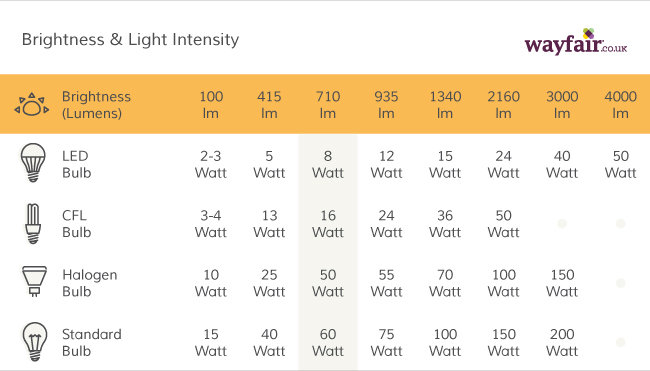
The light output of LED bulbs is measured in lumens (lm) rather than the traditional watts. The more lumens, the more light intensity and brightness. LEDs consume significantly less power than conventional light sources, partly because they emit no heat. The chart below compares power consumption and brightness of LEDs to the classic light bulb, halogen and energy saving lamps.
Light temperature: warm white or cool daylight?
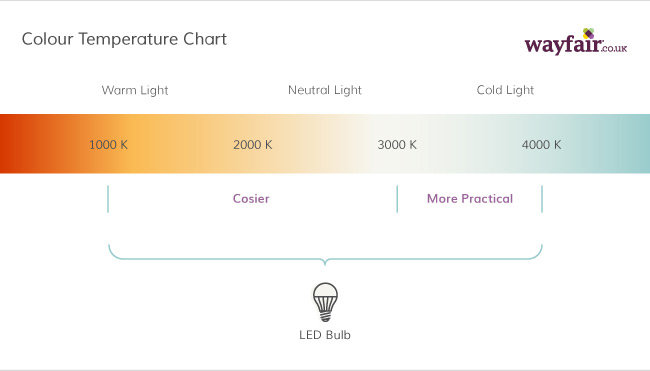
While it depends on a number of factors, every person has their own idea of what pleasant and unpleasant light looks like. This impression is known as colour temperature, and it's measured in Kelvin (K). You can buy light bulbs from around 2000-6000 K.
The higher the Kelvin value, the cooler and less yellowish light appears to the human eye. Candlelight, for example, has a colour temperature of approximately 1850 K. Daylight lamps on the other hand produce a very cold white and imitate the spectrum of the midday sun (without any heat radiation).
Conventional incandescent bulbs produce a yellowish, cosy warm white at around 2500 K and a halogen light produces a less warm 3000-3400 K. Lighting experts advise using warm white lighting in spaces such as the living room, bedroom and dining room, because people perceive this light as calming and cosy.
The graph below gives you an idea of different light temperatures and matching bulbs, and how LED lighting can provide warm, neutral or cold white light depending on how and where you want to use it.
Bright Home Office or Cosy Living Room
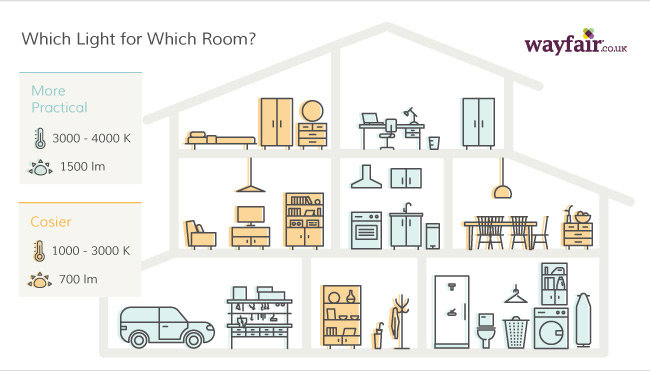
In practical, functional areas like your kitchen, office, laundry room, basement or garage, it's advisable to use LED bulbs with light temperatures from 3000-4000 K and about 1500 lumens (about the same light intensity of one to two 100-watt bulbs) This type of bright neutral white or white daylight-type light keeps colours looking natural and can help us feel more 'awake' and focused.
Rooms for relaxing—like your living room or bedroom—work well with 300 to 700 lumens at a comfortable 2500 K. The image below gives you a rough idea of what type of light works for what room:
Of course, there's no set rules and it's up to you and your personal taste.
Which bulb shape?
The most common basic shapes for LED bulbs include floodlights, spotlights, A-line bulbs and candle bulbs. As LED lights are directional, it's important to choose the right bulb shape so that light is channelled in the exact way that you'd like it to be. For floor and table lamps, A-line bulbs are better suited; candle lights are designed for chandeliers, while floodlights are better for outdoor and recessed lighting. Still not sure about the shape? Our Light Bulb Buying Guide is here to help.
Which bulb fitting?
The most common types of bulb fittings (or bases as they're sometimes referred to) are Bayonet, Edison screw and push-fit (or pin). LED light bulbs still use these. If you're unsure about which one you need, look at your old or existing bulb to find the exact match. The most popular used fitting in the UK is the Bayonet, which is distinguished by its 'push and twist' installation method. Still not sure about the fitting? Again, our Light Bulb Buying Guide will point you in the right direction.
The two threaded sockets E27 and E14 you might recognize right away, but it can be tricky to identify the three socket types (especially since there are actually more than 50 different ways in the EU to join a bulb with an individual power supply). The versions shown above, there is a rule of thumb, because the number on the label is derived from their respective diameter and spacing of the electrical contacts in millimetres.
To go when buying a lamp sure to have the right bulbs at the correct bulb socket, write down a memo with the label or the values. You can use to compare the original packaging or the spare lamps.
IP Protection Classes for Lights
A relatively unknown aspect of bulbs is how well they protect against dust, humidity or even splashes of water (it's not often that we buy a complete, watertight lamp system for the pool, after all). Therefore Wayfair divides the scale of the various protection classes into three broad areas.
You can therefore choose a bathroom lamp knowing that bulbs that work in it are splash-sensitive. A two-digit number such. B. "IP55" determines the safety class, where the first digit from 0 to 6 to protect against foreign bodies such as dust and the second digit from 0 to 8 indicating the protection against humidity and exposure to water. The table below lays these out, but for more information, check out IP rating guide.
Tip: For more expert advice on lighting, read:
- Your Go-To Guide for Everything Lighting
- Your Guide to IP Rating and Lighting Classifications
- Set the Mood With Our Guide to Ambient Lighting
