Choosing the Best Microwave For Your Kitchen
A small but mighty appliance.
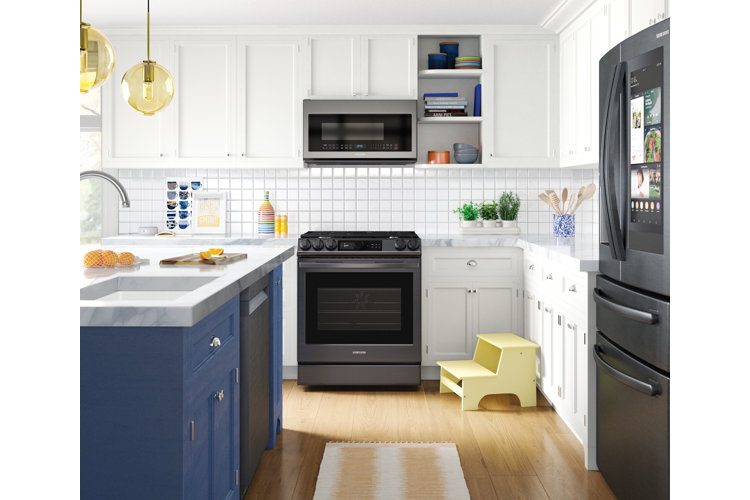
Thanks to their speed and simplicity, microwaves are must-have kitchen appliances. But with advancing technology, buying a microwave isn't as straightforward as it once was. If you're in the market for a microwave but need some help choosing the best model for your kitchen, we're here to guide you. Below we cover all the different types of microwaves available, including microwave installation types, microwave capacities and microwave features.
Microwave Buying Guide
Best Microwave Installation Types
Countertop: These standard microwaves are the go-to if you don't have the space or desire to install one in your kitchen. All you need to do is place it on a countertop and plug it in. A countertop microwave's freestanding nature allows you to position it wherever there's ample space and a nearby electrical outlet. The only downside to this type of microwave is the loss of counter space, but if you have some to spare, it's the perfect choice.
Built-In: Built-in microwaves are designed to be installed in a cabinet space. Though they do require professional installation and could turn out to be a bit more expensive than other microwave types, built-in microwaves don't take up any countertop space and can really enhance the functional beauty of your kitchen.
Over-the-Range: Over-the-range microwaves are designed to be installed just above your kitchen range. These microwaves have a bonus feature – they double their own hoods. A fan and ventilation system are located on the underside of these microwaves to eliminate smoke and odours from whatever you're cooking below. Some models come with temperature sensors or task lighting to illuminate the cookspace. An over-the-range microwave is the best microwave for you if you're also interested in equipping your kitchen with a range hood.
Drawer: Sleek, modern and loaded with user-friendly features, drawer microwaves are on the cutting edge of microwave technology. Instead of swinging open, these microwaves slide open like drawers. Typically installed under countertops and closer to the floor, drawer microwaves are an accessible option for wheelchair users.
Best Microwave Sizes & Interior Capacities
Most microwaves are 73–76cm wide, 38–40cm deep, and 40–45cm tall. Though microwaves are available in a wide range of sizes, their capacity will dictate how small or large they are. Most microwaves have capacities of 13–42 litres, which is adequate for most single and multi-serving defrosting and reheating tasks.
Compact/Small: Up to 20 litres
Midsize: 21-25 litres
Full-Size: 26-30 litres
Extra Large: 30+ litres
Best Microwave Wattage
A microwave's wattage describes the electrical power capacity the appliance has. Microwave wattage can correspond with microwave size and capacity, so smaller microwaves tend to have lower wattages. Microwaves with lower wattages emit less power than those with higher wattages. They're also more cost-effective and can help you cut down on your electrical power consumption. That said, microwaves with higher wattages can heat food quicker and more thoroughly. Despite them being a bit more expensive, microwaves with higher wattages have more cooking capabilities than microwaves with lower wattages and can be the best choice for heating up larger quantities at once.
700–850 watts:
900–1000 watts:
1050–1150 watts:
1200–1500 watts:
Air Fryer Cooking: Air-fryer cooking microwaves incorporate convection heating to give foods an even crispness. Air frying is an amazing, healthier alternative to oil frying. Thanks to their convection-heating technology, air-fryer cooking microwaves also tend to have more cooking capabilities.
Rotating Turntable: Most microwaves come with turntables that rotate the food as it is being cooked. The rotation helps disperse the heating microwaves more evenly throughout the food and prevents burning.
Safety Lock: If you're concerned about small hands at play around the microwave, opt for a model that comes with a safety lock. These safety locks vary in form and function; some lock the microwave door so that it can't be opened, others lock the control pad so that the microwave's buttons can't be used.
Sensor Cooking: Some high-tech microwaves employ sensors that detect moisture levels in food as it cooks. The microwave then modulates its cooking intensity and cook time to ensure the food is cooked perfectly.
Retro: Worried a modern-looking microwave won't fit in with your kitchen's decor? Opt for a retro microwave with the look of a 1950s device but the technology of a modern one.
Tip: For more ideas and inspiration for your kitchen, check out:
- 5 Cooker Hood Ideas To Boost Your Kitchen's Design
- The Coolest Guide to Mini Fridges Out There
- The Complete Oven Buying Guide
