This is How to Measure a Shower Door
Find the perfect fit before full installation.
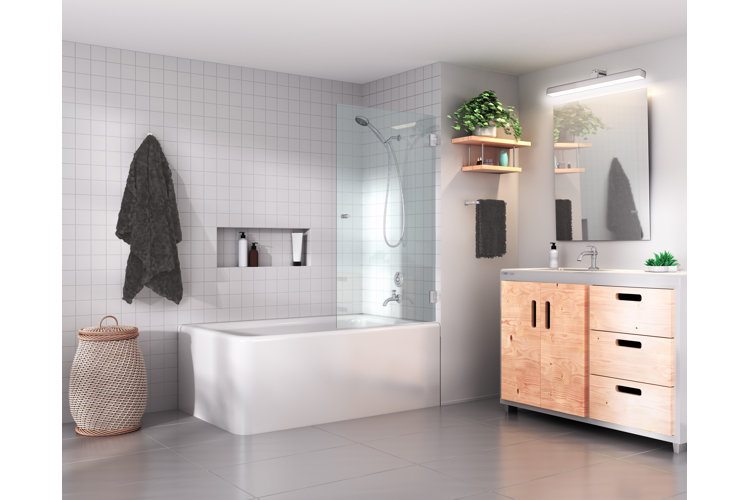
Knowing how to measure for a glass shower door is the first step in upgrading your shower enclosure. Whether you're renovating your bathroom or searching for a new shower door, read our guide to learn how to measure shower doors.
Overview
Types of Shower Door
How to Measure for a Glass Shower Door
Types of Shower Door
Sliding: This compact option slides to the side rather than opening out or inwards. A sliding door can either slide on one or both sides of the glass pane.
Pivot: This swinging option opens like a traditional door. A pivot door is hinged at the corners, allowing the glass door to open inward and outward.
Hinged: This popular door is held to your shower wall or a fixed glass piece with hinges. The glass panel of a hinged door opens outward.
Fixed: This fixed glass panel offers the privacy of a shower door but no motion is required. There is no sliding or opening with this option.
Folding & Bi-Fold: A folding shower door folds into itself when you pull or slide it open, whilst a bi-fold door comes with parts that both fold and are recessed. Folding doors minimise the amount of space needed in your bathroom for the door to open.
Tip:To give your shower a sleek and ultramodern finish, install a frameless shower door instead of a framed shower door. Frameless shower doors – usually sliding or swinging – install snugly in a shower opening and are virtually invisible thanks to their clear glass and frameless design.
Measure the doorways leading up to your bathroom to ensure you can carry the shower door through your house without damaging the glass. Make sure there is room to turn your shower door if necessary.
What You'll Need:
- Min 2x people
- Tape measure
- Pen and paper
- Level
Step 1: Make a Sketch of Your Shower
With your pen and paper, sketch a small diagram of your shower. Use this visual reference to label your measurements.
Tip: Take each measurement twice and if your numbers differ, go with the larger one. Always round to the nearest 1/16ʺ for accuracy. If you opt for a custom shower door, knowing precisely how to measure for a glass shower door is even more essential.
Step 2: Measure the Width
Using your tape measure, measure the width of your shower from one side of the wall to the other. Measure the width in three spots – along the base, middle and top. (Image 1)
If you have a neo-angle shower, measure the width in sections along the base of the shower pan. (Image 2)
Step 3: Check if the Walls Are Plumb
Older homes or showers may not have walls that are perfectly straight. If your wall is plumb, meaning straight up and down, you should have a worry-free shower door installation. If your walls aren't plumb, you should seek the help of a professional when installing your shower door.
To check if your shower walls are plumb, place your level flat against each shower wall. Look at the bubble on the level and see if it is centred between the two indication lines. If the bubble is centred, the wall is plumb. If the bubble is not centred, angle the level away from the wall until it is. Holding the level in this position, mark the distance between the wall and the level on your measurement sheet. Share these measurements with the professional who will be installing your shower door. Do this at the bottom and top of each wall to ensure they are plumb all the way up. (Image 3)
Step 4: Measure the Height
Measure the distance from the base of your shower to its top. If your shower door will rest on a threshold, have your measurement begin at the top of this 'base' (Image 4). If your desired shower door size is shorter than your shower’s overall height, only measure up to this point. (Image 5)
Step 5: Measure the Opening
If your new shower door will be the same style as your current door, measure the width of the current door and use that measurement as a reference. If your new door will sit over a section of the threshold that you have previously measured, use this width (Image 6). If your shower door will be smaller than your threshold’s width, measure your desired width. An example would be a fixed shower door that only covers three-fourths of your threshold’s overall width. (Image 7)
If your new door will swing outward (hinged, pivot, or folding doors), take your tape measure and make it the desired width of your shower door, then place one end of the tape measure where the door’s hinge would be. Holding it in place, pull the tape measure in a semicircular motion. This will determine if there is sufficient room for it to open without hitting a wall, door, or vanity. (Image 8)
Tip: Looking to add more upgrades to your shower? Check out:
- Freshen Up Your Morning Routine With These Modern Shower Heads
- How to Tile a Shower Wall Like a Pro
- 11 Ways to Jazz Up Your Shower Tiles
