Familiarise Yourself With These Kitchen Knives
Know your cleaver from your santoku.
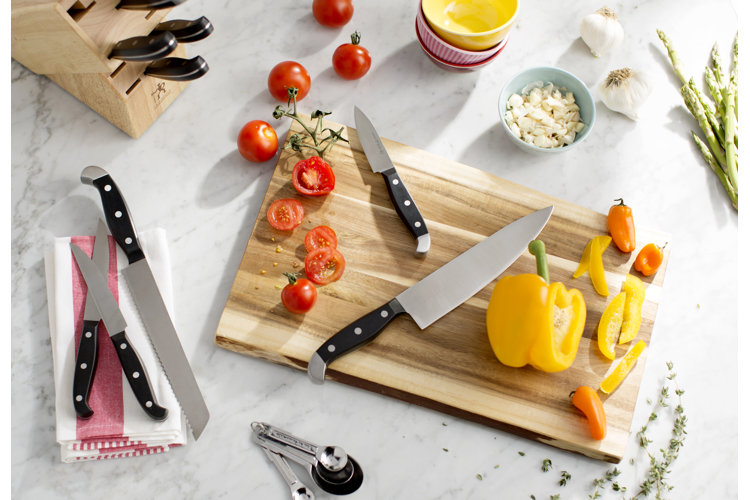
Kitchen knives are indispensable tools for chefs of every skill level. Understanding the uses of the different types of kitchen knives is the first step in elevating your culinary game. Once you know the uses of the types of kitchen knives, you can stock your kitchen with the best types of kitchen knives for your cooking needs.
Types of Kitchen Knives
Chef's Knife
- An all-purpose knife sometimes called a French knife or cook’s knife.
- Blade usually 6” – 12” long.
Use it for: chopping, slicing and dicing thicker cuts of fruits, meats and veggies.
Carving Knife
- Often sold in sets that include a carving fork.
- The beveled or smooth blade can vary in flexibility depending on the type of meat it's made to carve.
- Blade usually 8” – 15” long.
Use it for: fileting large fish or carving large poultry or roasts.
Steak Knife
- These blades are usually serrated (sharp with saw-like teeth).
- Vary in thickness.
- Usually come in sets of 4 – 6.
- Blade usually 4” – 6” long.
Use it for: cutting portions of main dish servings such as chicken or steak.
Tip: Why have just one steak knife when you can have a set? Check out our steak knife set guide for more info.
Paring Knife
- Small with a sharp blade that's rounded on the cutting side.
- Light and easy to maneuver.
- Blade usually 3” – 5” long.
Use it for: coring, cutting, mincing and peeling small ingredients.
Utility Knife
- Shares qualities from a chef's knife and a paring knife.
- Lightweight and small.
- Blade usually 4” – 7” long.
Use it for: cutting and prepping medium size fruits and vegetables.
Santoku Knife
- Considered the "Asian chef's knife."
- Blade is thinner and shorter than a chef's knife, with a straighter cutting edge.
- Blade usually 4” – 7” inches long.
Use it for: cutting foods into fine pieces or butterflying poultry.
Bread Knife
- Has a serrated edge (sharp with saw-like teeth).
- Can be difficult to sharpen.
- Blade usually 8” – 10” long.
Use it for: food that is hard on the outside and soft on the inside such as crusty bread
Fillet/Boning Knife
- Narrow and easily manipulated.
- Blades vary in rigidity depending on the size of the meat they're made to cut.
- Blade usually 4” – 7” long.
Use it for: removing the main bone from meat like ham.
Cleaver/Butcher Knife
- Blade is broad, heavy, and rectangular.
- Weight and thickness is enough to split bone and the broad side can be used for crushing.
- Blade usually 6” – 7” long.
Use it for: cutting and stripping large cuts of meat and bone or trimming fat.
Nakiri Knife
- Japanese-style chopping knife.
- Long, marbled blade with a flat tip.
- Blade usually 6” – 7” long.
Use it for: chopping any kind of vegetable without crushing or tearing it.
Tomato Knife
- Light, thin serrated blade with an upturned end.
- Blade usually 4.75” – 5” long.
Use it for: slicing tomatoes without crushing them.
Tip: Avoid the dishwasher. All knives should be cleaned with hot water, soap and a non-abrasive scrubber such as a sponge. Knives should never go in the dishwasher because the force of the water can dull the blade and sometimes cause handles to warp.
Popular Kitchen Knife Materials
High-Carbon Stainless Steel: High-carbon stainless steel is the most popular steel type for high-quality kitchen cutlery. The material is incredibly hard and will maintain a sharp edge even after some wear. It resists stains only if it's dried off immediately and may still require some stain maintenance.
Stainless Steel: In spite of its name, stainless steel isn’t resistant to rust and stains and does require some upkeep to remain in good condition. Stainless-steel knives dull faster than high-carbon stainless-steel knives, but they’re a popular choice for knife sets as they are relatively inexpensive.
Ceramic: Made from zirconia ceramic, these knives are lightweight, stain and odour-resistant and incredibly durable. Ceramic knives will take years to dull and can be used for precision jobs, but can chip or break if handled roughly. If a ceramic knife does dull, it’s best to get it sharpened by a professional.
Carbon Steel: Carbon-steel blades are for the pros – they are super sharp and ultra precise but require a lot of upkeep and regular sharpening.
Complementary Pieces
Round out your cutlery collection with these must-haves.
Knife Sharpeners: With options such as honing steels to electric knife sharpeners, these tools will help you combat dullness.
Knife Blocks & Storage: Keep your blades safe and dry with a knife block or drawer storage tray.
Chopping Boards: Protect your counter or tabletop when putting your knife skills to the test with a cutting board. They come in many sizes, shapes and materials so you’re sure to find one that best suits your needs.
Kitchen Scissors: Easily cut through poultry joints and open stubborn packages with these versatile and multipurpose tools.
