
METAL-TIME
Unique Mechanical Models made of Pure Steel







METAL-TIME
61 Items
Decorative Puzzle Or Game
By METAL-TIME
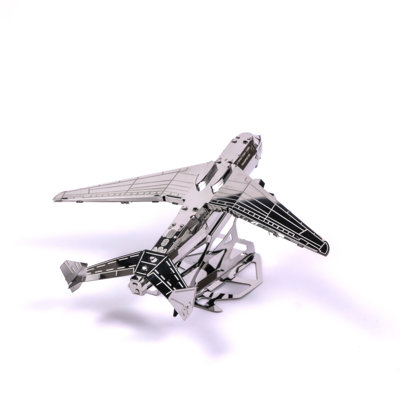
Together with Antonov, Metal Time supports Ukrainian aviation rebuilding programs, including: - the restoration of the AN-225 Mriya aircraft; - training of new pilots and aircraft engineers; - the restoration of houses of Antonov employees, destroyed during the war. In 1988, Antonov Aviation built the world's largest cargo aircraft, the AN-225, named Mriya (translated from Ukrainian, means Dream) and landed it at the Gostomel airport, in Kyiv, Ukraine. Its specifications were astonishing: it was 275 feet long, 288 feet wide and 59 feet tall. To understand just how enormous Mriya was imagine a six-story house with four entrances. The Mriya weighed 350 tons (700,000 lbs.) and could lift another 250 tons (500,000 lbs.). This was an absolute record. Mriya was a beast. No plane on earth could come close to that much carrying capacity. For example, Mriya could transport a herd of 42 elephants, or more than 1.8 million iPhones. Over the years, the Mriya AN-225, has transported giraffes, yachts, parts of power plants and other large items other planes could not transport. Mriya carried the first Soviet "Shuttle" called "Buran" made its longest flight. After a short flight into space, the Buran remained grounded, but the Mriya would continue to soar! Such an amazing feat of engineering has rarely been seen on earth. Each takeoff and landing of the Mriya became spectacle, attracting the press and people from all over the world. You can destroy a plane, but you can't kill a Dream. One day Mriya will fly again. In memory of the amazing, unique, aircraft, Metal Time presents the Ukrainian Dream SE licensed model. It is the result of a collaboration initiative between Antonov, Metal Time, and the Ukrainian Postal Service, Ukrposhta. Ukrainian Dream is an officially licensed model. So, we have paid great attention to every possible detail. The design case and movement were designed with great precision, to ensure each part moved correctly, and was visually accurate. The aircraft rests on a stand and can be easily removed. In addition to all necessary parts for assembly, the set includes the limited-edition Mriya the Dream” postage stamp. Along with the Stamp, is a certificate of appreciation and support from Antonov Aviation, documenting your support of Mriya, and the aviation rebuilding programs. Together with Antonov, Metal Time supports Ukrainian aviation rebuilding programs, including: - restoration of the AN-225 Mriya aircraft; - training of new pilots and aircraft engineers; - restoration of houses of Antonov employees, destroyed during the war.
Decorative Puzzle Or Game
By METAL-TIME
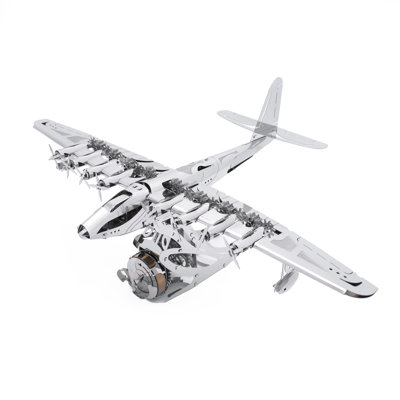
A Mechanical Marvel Inspired by the Legendary Spruce Goose. Metal Time, the epitome of precision engineering, is proud to introduce the Celestial Hercules — a self-assembly model paying homage to the iconic Hughes H-4 Hercules, commonly known as the Spruce Goose. Crafted entirely from polished stainless steel, this mechanical masterpiece captures the essence of the legendary aircraft’s remarkable history and unique features. Constructed during a time of wartime aluminum restrictions and weight concerns, the aircraft earned the moniker “Spruce Goose” from critics, despite being predominantly made of birch using the Duramold process. Mechanics, humorously referring to it as the “Birch Bitch,” offered a more accurate yet socially unconventional nickname. The Hercules holds the distinction of being the largest flying boat ever built, boasting the widest wingspan of any aircraft until the Scaled Composites Stratolaunch took flight on April 13, 2019. Currently, the Spruce Goose is well-preserved and on public display at the Evergreen Aviation & Space Museum in McMinnville, Oregon, USA, after being showcased in Long Beach, California, from 1980 to 1992. The Celestial Hercules is a testament to innovation and engineering prowess. Inspired by the Spruce Goose, our model recreates the largest flying boat ever built, with meticulous attention to detail. Despite the historical “unhappiness” of the original plane, we’ve brought it to life, defying history and presenting a mechanical marvel that conquers the sky.
Model Car Or Vehicle
By METAL-TIME
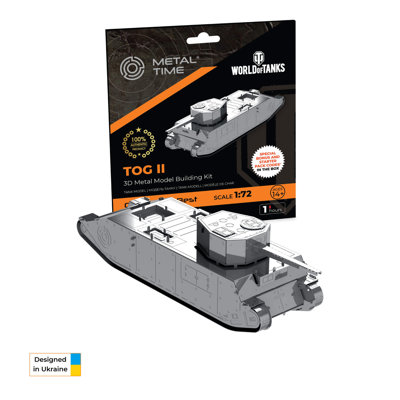
Developed for trench warfare. Initially, the armament was to be placed in the front part of the hull and side sponsons. However, later it was decided not to add sponsons but to mount a turret. By 1943, when the TOG 2* was completed and ready for trials, it was already obsolete. The vehicle never entered service. Before World War II, the British military was concerned with building a fleet of new tanks. It was to be headed by a new super-heavy tank for storming enemy positions. The British had experience in building such vehicles since World War I. They were clumsy huge moving fortresses with powerful armor and armament. Therefore, the object called "TOG II" also had these qualities. The armored monster with a weight of 82 tons, a height of 3 m, and a length of more than 10 m had to strike fear into the enemy. Like its predecessors, the running gear of the tank was concealed inside the hull, and the tracks protruded from the central part, which was an armored capsule for weapons and a crew of six. At first, the designers had an idea to hang the armament also on the sponsons, but then it was moved to the front of the tank and the sponsons became part of the main body. Hatches were made in them for the ejection of shells and loading of ammunition. The main gun of the “TOG II” was a 75mm “QF 17 pounder” anti-tank gun, the best in its class in service in Great Britain. In addition to this, the front of the tank had a slot for a 7.92mm "BESA" machine gun. "The TOG II” was propelled by a 600 hp “Paxman-Ricardo” engine. The speed of the tank was not high, but its purpose was not to make a rapid assault but to destroy trenches and fortifications of the enemy and destroy tanks and manpower of the enemy. The role of the tank as a mobile gun was also considered, but later this idea was rejected.
Geography Decorative Puzzle Or Game
By METAL-TIME
Free Delivery
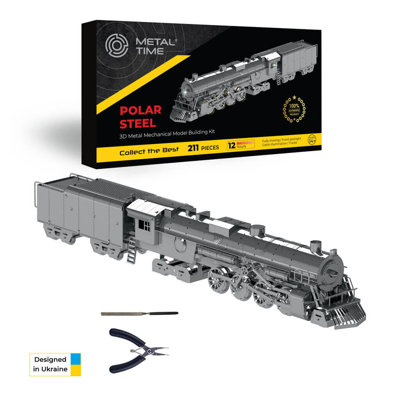
The train is waiting for you. "Polar Steel" is journeying to the North Pole. Boards the train and race north over mountains and through boreal forests inhabited by timber wolves as well as rabbits, but this train never slows down. Build "Polar Steel" train with your own hands! At the very late hour of the night before Christmas, when even the most children fall asleep, and only the whistling of a blizzard is heard outside the window, a bright beam of a spotlight suddenly cuts through the snowy haze and it appears in clouds of smoke and steam. Try not to fall asleep, and you will definitely get into his car. This train will take you to the North Pole, where Santa Claus himself collects gifts. Neither high mountains, nor endless snow-covered fields, nor an impenetrable forest will stop the train, and it will definitely arrive on time. Yes, this is the Polar Express from the animation of Robert Zemeckis - an attentive viewer will exclaim. And it is true. It was this cult film that inspired the designers of Metal Time, creating the Polar Steel model. The railway is a huge fascinating world for romantics who dream of traveling, fans of the history of the development of technology and design lovers, because every step in the development of railways is associated with millions of original technical solutions. Therefore, the model of the railway is the eternal dream of the overwhelming number of children and adolescents. Every aspect of railway technology is of interest: tracks, wagons, locomotives and buildings. Someone likes electric locomotives, and someone is still passionate about steam technology. And indeed, the locomotives from the fire-breathing dragons of the childhood of those over 50 have turned into relic samples, of which there are very few left in the real world. Therefore, the embodiment of steam locomotives in the form of self-propelled models is a successful way to win the hearts of tinkerers. Engineers, constructors and designers of "Metal Time" tried and created a new designer for self-assembly called "Polar Steel". This is a model of a ten-axle steam locomotive with a closed tender. Thanks to the use of colored stainless steel, the model has acquired unique color accents. Tender, cab. Tanks and wheel faces received a matte blue color. The shell of the cauldron has become a dull dark grey. Pipes and fittings, the boiler cover, as well as the details of the lantern are highlighted in matt yellow. As a result, the aesthetics of the steam locomotive has completely changed, and it is no longer associated with black coal, fuel oil and smoke - a real fabulous express train. A sense of wonder is also created by sound and light effects. Yes, the Polar Steel model is equipped not only with an LED lamp, but also with a sound chip capable of making sounds characteristic of a moving steam engine and its horn. Add to that the rails and freewheeling wheels and here is another locomotive for the Metal Time railway hub. The perfect gift for any tech lover!
Figurines & Sculptures
By METAL-TIME
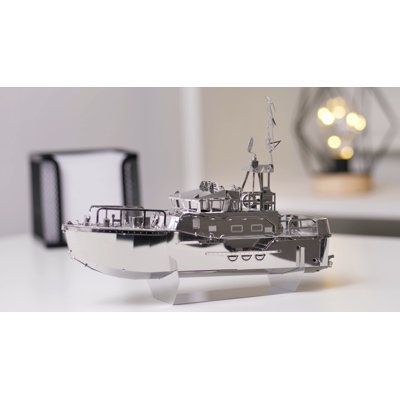
The old fellow CG-47305 was cutting through the turquoise waters of Bodega Bay, carrying out another patrol of marine reserves, when the radar detected an object moving at high speed. Of course, it could be the local "golden" youth from San Francisco, squeezing out all the power on a speedboat, or the poachers. And the team decided to check the ship, because this is the work of the coast guard. The patrol engine roared, and quickly picked up a cruising speed. Despite its age, it could still compete with glamorous motorboats. In addition, the crew knew these waters like the back of their hand. The chase was short and ended unexpectedly: an automatic fire was heard from the side of the boat. The bullets did not even scratch the armored side of the patrol boat, but it became clear to everyone: the case was taking a criminal turn. The crew commander notified the police and decided to continue pursuit. The patrol boat pressed the intruders' boat closer and closer to the shore. The criminals tried, but there is nowhere to hide in the ocean.
Free Delivery
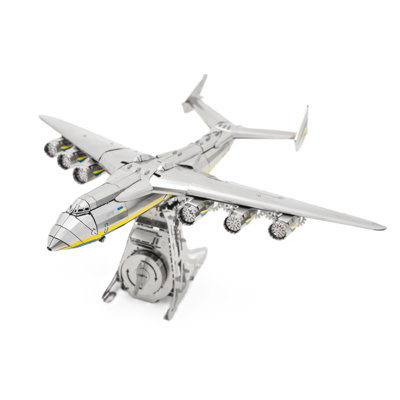
Mriya - the world’s largest transport aircraft AN-225 built by Ukrainian engineers and aircraft builders. Its codename is translated from Ukrainian - a Dream. This aircraft was the flagship of the world aviation fleet. The dimensions of this aircraft were indeed unique: Its length is 84 meters, its height is 18.2 m. To understand these figures, imagine a six-story building with four entrances. The “Mriya” weighed 550 tons and could lift another 250. This is an absolute record among the heavier-than-air vehicles that have ever been airborne on the planet. "Mriya" could transport a herd of 42 elephants, for example. Or a million iPhones. Or a whole Boeing 737. In the history of the flights of the Mriya AN-225, there were episodes of transportation of giraffes, yachts, and parts of power plants. On its fuselage, the first Soviet «Shuttle» called «Buran» made its longest flight. At the end of February 2022, during the Russian attack, the Mriya was destroyed. but the dream won`t be demolished. But engineers of “Metal Time” revive the plane as self-assembly scale model. Here is the Exclusive Edition of the awards winning “Ukrainian Dream” model. Its specifications were astonishing: it was 275 feet long, 288 feet wide and 59 feet tall. To understand just how enormous Mriya was imagine a six-story house with four entrances. The Mriya weighed 350 tons (700,000 lbs.) and could lift another 250 tons (500,000 lbs.). This was an absolute record. Mriya was a beast. No plane on earth could come close to that much carrying capacity. For example, Mriya could transport a herd of 42 elephants, or more than 1.8 million iPhones. Over the years, the Mriya AN-225, has transported giraffes, yachts, parts of power plants and other large items other planes could not transport. Mriya carried the first Soviet "Shuttle" called "Buran" made its longest flight. After a short flight into space, the Buran remained grounded, but the Mriya would continue to soar! Such an amazing feat of engineering has rarely been seen on earth. Each takeoff and landing of the Mriya became spectacle, attracting the press and people from all over the world. You can destroy a plane, but you can't kill a Dream. One day Mriya will fly again.
People Figurines & Sculptures
By METAL-TIME
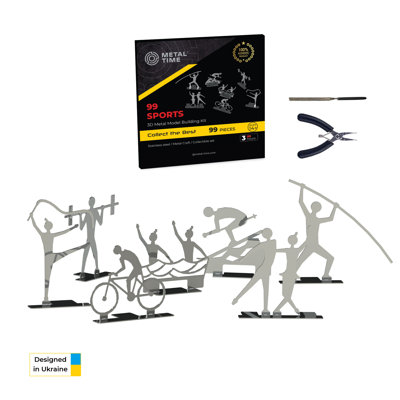
Movement is life. Literally. Regular physical activity renews body tissues, activates metabolism, and forces the body to continue to develop and get rid of obsolete "spare parts", which ultimately prolongs an active life. Even just walking, working or shopping, a person develops his body. And sport is a concentrated activity that helps the body to achieve perfection in one aspect or another. Plus, for people who go in for sports, and who watch the victories of the human spirit and body, this is a very useful activity. Excitement, bursts of adrenaline, joy, empathy and satisfaction - these important psychological conditions help our body to maintain activity no less than physical activity. The engineers of Metal Time bring all these exercises in one box to fans of technical creativity. This is the constructor "99 Sport". By collecting all of these models, you will have a great experience of exercise for hands, brain and a feast of emotions.
Figurines & Sculptures
By METAL-TIME
Free Delivery
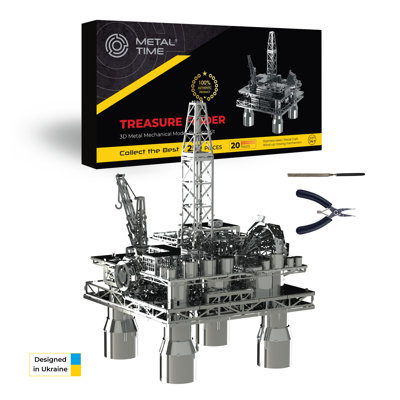
Our planet carefully stores its treasures and in order to get them, it is not always enough to dig a quarry, build a tower, or a mine on land. Increasingly, minerals have to be mined in areas covered with water. And the fantastic structures - floating platforms come to help. This is almost a city area on the water - with residential blocks, factory buildings, mechanisms, helipads and even its own tower - a rig or headframe, which give the platform a skyline. For the first time, an offshore oil rig was created in the United States in the 30s. Configurations and technologies have changed a lot since then. The highest offshore platform is in Norway. Its height is 472 meters, this is the height of the famous "Oriental Pearl" in Shanghai. The deepest harvesting is conducted by a platform in the Gulf of Mexico. Oil production is carried out from a depth of more than 3 km. These steel monsters are impressive. But very few people manage to see the offshore drilling platform live.
Decorative Puzzle Or Game
By METAL-TIME
Free Delivery
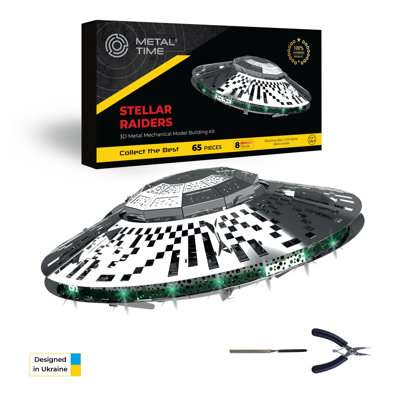
"Ancient astronauts" refers to a pseudoscientific hypothesis, that intelligent extraterrestrial beings visited Earth and made contact with humans in antiquity and prehistoric times. Proponents suggest that this contact influenced the development of modern cultures, technologies, religions, and human biology. A common position is that deities from most, if not all, religions are extraterrestrial in origin, and that advanced technologies brought to Earth by ancient astronauts were interpreted as evidence of divine status by early humans. Back in 1948, an object, which is still considered an alien ship, fell to Earth near the American town of Roswell. However, no one saw such devices up close either then or in all subsequent years. However, the image of a “flying saucer” launched to the masses by journalists has become a recognizable meme that has become a phenomenon of mass culture. "Metal Time" creates models of any devices that are amenable to engineering analysis and design implementation and cannot stay away from objects that excite people's minds. Therefore, in the new model for the DIY kit "Stellar Raiders" all the recognizable features of alien ships from outer space were collected. Now you do not need to go to Roswell to search for a "flying saucer". It will land right at your home! “Metal Time” engineers took the shape of a "flying saucer" as a basis, as well as numerous legends that aliens abduct people and animals. To achieve the right level of inspiration to create the “Stellar Raiders” model, all team crew had to re-read a mountain of fantasy literature and review many comics and 10 seasons of the X Files series. Due to this, the result turned out to be remarkable, and it will appeal to both fans of the idea of an imminent alien invasion and skeptics. Because the Stellar Raiders model is extraordinarily beautiful. Designers used many artistic elements, colored stainless steel, complex etching methods, die-cuts, lighting effects and complex mechanisms. All off that will offer the owners of the construction set a very difficult challenge, because in order to assemble this model they will have to apply their skills acquired with our previous construction kits. On the other hand, replenishing the collection of Metal Time models with a ready-to-fly UFO model will be a welcome reward for fans of metal DIY models and will decorate any trophy store.
Decorative Puzzle Or Game
By METAL-TIME
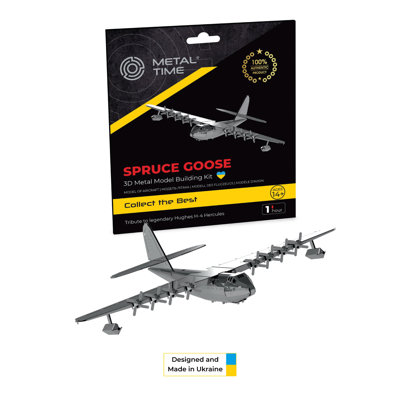
The Hughes H-4 Hercules (commonly known as the Spruce Goose) is a prototype strategic airlift flying boat designed and built by the Hughes Aircraft Company. Intended as a transatlantic flight transport for use during World War II, it was not completed in time to be used in the war. Here history takes flight with the SPRUCE GOOSE steel DIY model kit by Metal Time Models. Step into the golden age of aviation and relive the marvel of the Hughes H-4 Hercules, affectionately known as the Spruce Goose. This steel model kit pays homage to the iconic prototype strategic airlift flying boat designed and built by the legendary Hughes Aircraft Company. Crafted with precision and passion by Metal Time Models, the SPRUCE GOOSE DIY model kit allows enthusiasts of all ages to recreate the awe-inspiring design of this colossal flying machine. The Hughes H-4 Hercules was conceived as a transatlantic flight transport during World War II, but despite its grand aspirations, it was not completed in time for wartime service. Now, you have the chance to build a stunning steel replica of this historic aircraft.
Decorative Puzzle Or Game
By METAL-TIME
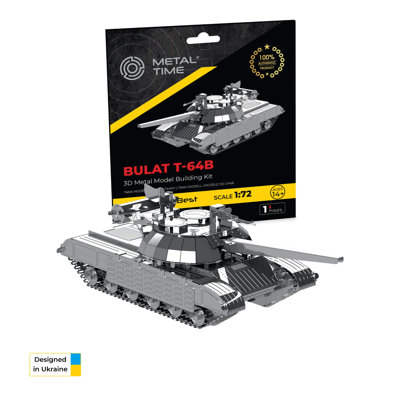
The modernisation programme, transforming T-64 MBTs to BM Bulat MBTs, focused on improvement of its fire power, mobility and protection. The upgraded sights and aiming devices include a Buran-E night vision system for detection, identification and engagement of targets, and a TKN-4S, the sighting system for the tank commander. The modernisation work included installation of a 1G46M sight and a TO1-KO1ER night sighting system or Buran-Catherine thermal imager for the gunner, some 2E42M main armament stabiliser units, a 1V528-1 tank ballistic computer, a TAKO-621 guided weapon system, a 1ETs29M control system for anti-aircraft machine guns and a PNK-5SR observation and sighting system. The “Bulat” T-64 is the main battle tank of the Ukrainian Armed Forces. It is the result of a rethinking and deep modernization of the Soviet T-64 tank. Over decades of painstaking work, designers were able to bring the fire control, protection, and firepower systems up to the level of modern T-80 and T-84 models. Due to its predecessor, “Bulat” has a recognizable design: side protection side screens, a low-profile turret equipped with passive protection plates, and an ammunition bunker. “Bulat” T-64 is one of the main mechanized combat units in the Ukrainian army. Inheriting the simplicity of the base model, it has significantly improved in characteristics. This combat vehicle can reach speeds of up to 60 km/h on the highway and has a combat range of up to 385 km. The turret turning speed is 40 degrees per second, allowing the tank to quickly respond to threats.
Decorative Puzzle Or Game
By METAL-TIME
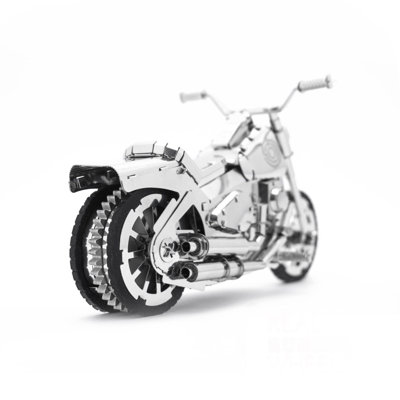
In 1901, William S. Harley drew up plans for a small engine with a displacement of 7.07 cubic inches (116 cc) and four-inch (102 mm) flywheels designed for use in a regular pedal-bicycle frame. Over the next two years, he and his childhood friend Arthur Davidson worked on their motor-bicycle using the northside Milwaukee machine shop at the home of their friend Henry Melk. It was finished in 1903 with the help of Arthur's brother Walter Davidson. The sun is quickly setting in the horizon, making the mountains look like lava flowing down a volcano. The highways lines shoot by like they were tapped on the road; the hot air is blowing in your face. And the sound of the motorcycle’s engine gives you confidence you will get to town before dark. The excitement of the sound of the engine revving through the open road flows through your body. And as you glide down the road on your steel horse, you have never more free. Harley Davidson is an American icon, a symbol of freedom, known by motorcycle enthusiasts around the world. Harley Davidson began its journey on the American roads in the early 20th century. Americans quickly fell in love with Harley Davidson. Word spread so fast that in 1920 the company became the world's largest motorcycle manufacturer. The name "Harley Davidson" is renowned to all motorcycle lovers. The American motorcycle has been the inspiration for countless books and movies. "Metal Time" presents Roadway Fantasy. Our homage to America's legendary motorcycle, Harley Davidson. The Metal Time's designers behind this model were motivated by the legendary Harley Davidson Model-F. To many, this two-wheeled mustang symbolizes motorcycle travel. The motorcycle has appeared in books, films, comics, and even video games. Harley Davidson is loved around the world and has a huge cult following. Harleys are known for their representation of freedom and independence. Regardless of the seeming conciseness of the name, the "Roadway Fantasy" model is very challenging. It has over a hundred parts, and therefore, it requires attention to detail so that you can proudly display your model.
Decorative Puzzle Or Game
By METAL-TIME
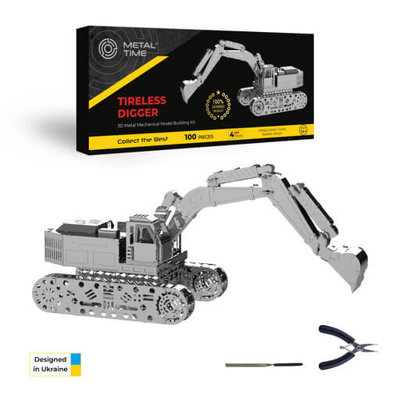
Excavators are heavy construction equipment consisting of a boom, dipper (or stick), bucket and cab on a rotating platform known as the "house".The house sits atop an undercarriage with tracks or wheels. All movement and functions of a hydraulic excavator are accomplished through the use of hydraulic fluid, with hydraulic cylinders and hydraulic motors. The invention of mechanisms has always been aimed to facilitate human labor. Therefore, in the era of large-scale construction in the 15-16 centuries, an earth-moving machine could not but appear. It was invented by Leonardo da Vinci. But the first excavator appeared only after 500 years. The conventional boom and the bucket machine was invented by William Otis. Since then, technology has come a long way, but the form and functionality of excavators have not changed conceptually. This is all the same combination of a crane and a bucket (shovel) for moving soil. Now earthen machines have many varieties and purposes. They perform their tasks on the surface of the earth, underground, and even underwater. Excavators have become one of the main helpers of people on the planet. The “Tireless Digger” self-assembly model has become a continuation of the collection of heavy special equipment in the “Metal Time” DIY kits. The excavator is a complex and spectacular machine that deserves its place among the collection of models in your home. Therefore, our engineers made it very realistic and functional. After assembly, which is a challenging and interesting process, the excavator model is even capable of digging soft soil such as sand. True, this can only be done by manually operating the boom and bucket. And the “Tireless Digger” moves on a caterpillar track independently with the help of a winding mechanism. The reliability of the details of the model, the presence of a spring winding mechanism, and a lot of components make the assembly of this model an interesting task with a consistently wonderful result.
Decorative Puzzle Or Game
By METAL-TIME
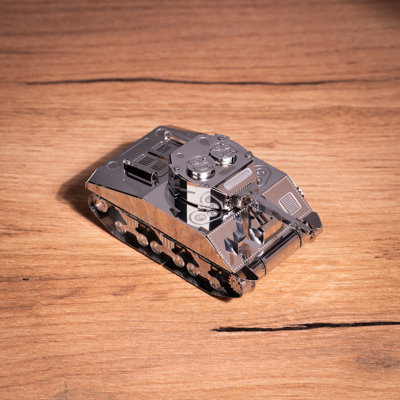
The first production version of the Sherman, the most common American tank, with an amazing total of 49,234 vehicles manufactured. The Sherman first saw combat in North Africa. The medium tank "M4" is one of the most mass-produced tanks of World War II. It stands alongside other legendary "victory tanks" as it successfully fought in many local conflicts even after the war. The "Sherman," named after a hero of the American Civil War, has become the subject of numerous books, films, and comics. Its successful design and the possibility of modifications made this tank almost irreplaceable in battles. The "M4" began serial production in 1942 and was adopted by the United States, Great Britain, and the Soviet Union. Over 50,000 tanks of various modifications were produced, but they all retained the original design. The "Sherman" was operated by two driver mechanics on the main platform, and three crew members in the turret were responsible for its combat power. The main weapon of the "M4" was a 75mm tank gun. In some modifications, it was a mortar or even a flamethrower. Machine guns or automatic cannons were used for close combat. The chassis consisted of three bogies with two rollers each on a spring suspension and leading wheels.
Decorative Puzzle Or Game
By METAL-TIME
Free Delivery
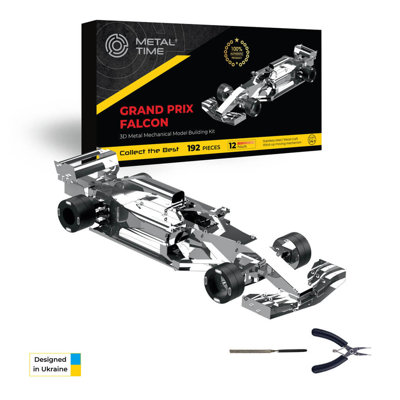
Formula One is the highest class of international auto racing for single-seater formula racing cars. The World Drivers' Championship, has been one of the premier forms of racing around the world since its inaugural season in 1950. The word formula in the name refers to the set of rules to which all participants cars must conform. A Formula One season consists of a series of races, known as Grands Prix, which take place worldwide on both purpose-built circuits and closed public roads. Hot afternoon, the smell of hot asphalt and burnt rubber. The stands are noisy in anticipation of the Grand Prix - top-class technoshows, pilot battles and the triumph of designers' skills. The roar of warming up engines easily covers the noise of the stands, because engines with a capacity of almost a thousand horsepower are trying their strength. And now - a green light and roaring fireballs take the pilots to the first circle. Everyone is extremely concentrated - both the audience, and the mechanics, and the daredevils who dared to defy the laws of physics. After all, this is Formula 1, the queen of motorsport, the main competition in the world of cars. Even people far from the racing theme know the names of the legendary F-1 pilots. Niki Lauda, Alan Prost, Jos Verstappen, Damon Hill, Ayrton Senna, Louis Hamilton, Sebastian Vettel and, of course, Michael Schumacher have long been among the cult characters of world sports and culture. Books are written about them, films are made, covers and front pages of newspapers and magazines are dedicated to them. No less famous are their "stables" - workshops where miracles of automotive technology are created - Formula 1 cars. McLaren, Ferrari, Lotus, Williams and Mercedes - each workshop accumulates the best mechanics and engineers to create seemingly impossible mechanisms. But every year, updated fireballs enter the tracks and the competition flares up with renewed vigor. In the collection of a car lover, there must be a Formula 1 car. At least his model. The Metal Time team created it for you. "Grand Prix Falcon" is a modular model of an open-wheel racing car (bolide) designed for racing in the top division of motorsport. To create a model, a standard racing car concept with characteristic components was chosen. Over the past decade, the overall concept of the car has not changed dramatically, limiting itself to minor improvements. Therefore, the Grand Prix Falcon model is relevant for this type of machine. The front spoiler, fairing and landing gear make up the front of the model. The wheels are made in the form of hollow cylinders attached to the suspension structure. The spoiler is a structure with wavy cuts that perform a decorative function and lighten the model. In the cockpit of the pilot, you can see the dashboard and steering wheel. Above it rises the central air intake. The main body with side air intakes hides the winding mechanism that drives the rear wheels of the model. The design is crowned by a rear spoiler.
STEM Decorative Puzzle Or Game
By METAL-TIME
Free Delivery
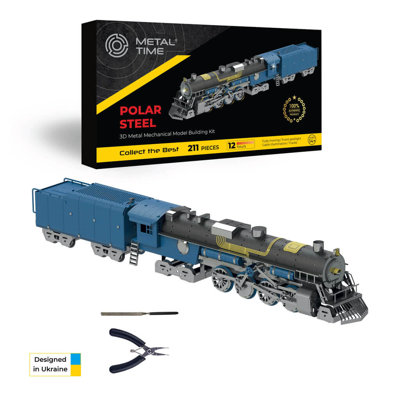
The train is waiting for you. "Polar Steel" is journeying to the North Pole. Boards the train and race north over mountains and through boreal forests inhabited by timber wolves as well as rabbits, but this train never slows down. Build "Polar Steel" train with your own hands! At the very late hour of the night before Christmas, when even the most children fall asleep, and only the whistling of a blizzard is heard outside the window, a bright beam of a spotlight suddenly cuts through the snowy haze and it appears in clouds of smoke and steam. Try not to fall asleep, and you will definitely get into his car. This train will take you to the North Pole, where Santa Claus himself collects gifts. Neither high mountains, nor endless snow-covered fields, nor an impenetrable forest will stop the train, and it will definitely arrive on time. Yes, this is the Polar Express from the animation of Robert Zemeckis - an attentive viewer will exclaim. And it is true. It was this cult film that inspired the designers of Metal Time, creating the Polar Steel model. The railway is a huge fascinating world for romantics who dream of traveling, fans of the history of the development of technology and design lovers, because every step in the development of railways is associated with millions of original technical solutions. Therefore, the model of the railway is the eternal dream of the overwhelming number of children and adolescents. Every aspect of railway technology is of interest: tracks, wagons, locomotives and buildings. Someone likes electric locomotives, and someone is still passionate about steam technology. And indeed, the locomotives from the fire-breathing dragons of the childhood of those over 50 have turned into relic samples, of which there are very few left in the real world. Therefore, the embodiment of steam locomotives in the form of self-propelled models is a successful way to win the hearts of tinkerers. Engineers, constructors and designers of "Metal Time" tried and created a new designer for self-assembly called "Polar Steel". This is a model of a ten-axle steam locomotive with a closed tender. Thanks to the use of colored stainless steel, the model has acquired unique color accents. Tender, cab. Tanks and wheel faces received a matte blue color. The shell of the cauldron has become a dull dark grey. Pipes and fittings, the boiler cover, as well as the details of the lantern are highlighted in matt yellow. As a result, the aesthetics of the steam locomotive has completely changed, and it is no longer associated with black coal, fuel oil and smoke - a real fabulous express train. A sense of wonder is also created by sound and light effects. Yes, the Polar Steel model is equipped not only with an LED lamp, but also with a sound chip capable of making sounds characteristic of a moving steam engine and its horn. Add to that the rails and freewheeling wheels and here is another locomotive for the Metal Time railway hub. The perfect gift for any tech lover!
Transportation Figurines & Sculptures
By METAL-TIME
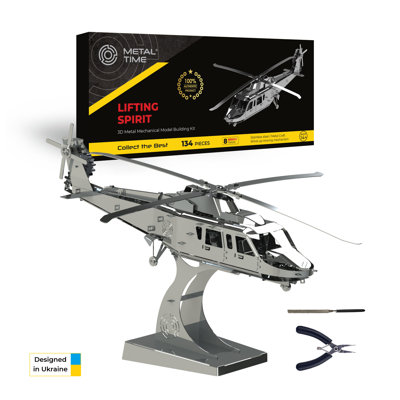
At the beginning of the 1900 century, Igor Sikorsky, a Ukrainian schoolboy from Kiev, saw a drawing of a flying machine having a Leonardo da Vinci propeller, and this gave spawned dreams of a manipulated flight in his head. When he was 19 years old and a student at the Kiev Polytechnic University, Sikorsky designed several aircraft models, including a helicopter. Sikorsky's first rotary-wing aircraft stayed on the ground, and for several years his focus was on airplanes. It was after 20 years that the engineer returned to helicopters. The machines were constructed in the USA and turned out to be the ancestors of the world's most successful model series. Advantageous of their capability to fly at low heights, lift off and land on small flat areas, and hang in the air, helicopters have turned out to be the primary type of supplementary aircraft - rescuers, carriers of goods, and people in remote areas, personal transport, and flying cranes
Decorative Puzzle Or Game
By METAL-TIME
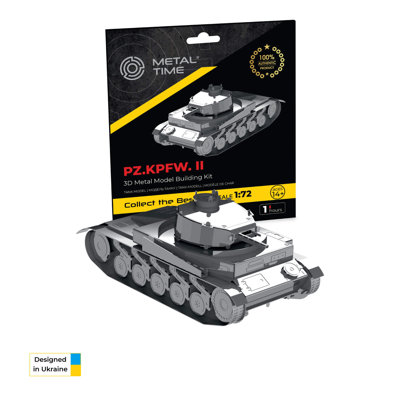
The last modification of the light Pz. II tank. The vehicle featured enhanced armor, the 2 cm KwK 38 gun and improved observation devices. A total of 524 vehicles were built from March 1941 through December 1942. This may sound strange, but the iron mechanical power of the Wehrmacht in World War II began with... a tractor. It was under the name "agricultural tractor LaS 100" that Germany produced the first combat tanks of the largest war of the 20th century. The modification of the basic model Panzer I became the light tank “Panzerkampfwagen II” or “Pz.Kpfw. II”. It was one of the most mass-produced combat vehicles of World War II. By 1942, when they gave way to heavy machines, more than 3,500 of them had been produced. This not-fast tank, weighing about 8 tons, could reach a speed of 40 km/h on the highway and was designed to cover infantry attacks. Its armor was sufficient to protect against small arms and mines, but artillery strikes were fatal to the Panzer II. Moreover, its firepower was hardly impressive. The main weapon of the tank was a 20mm automatic cannon. There were several weapons options - tank modifications with flamethrower systems and heavy machine guns as the main weapon exist. The main protection was the turret design with ricochet angles, which allowed for the softening or reflecting of enemy weapons hits.
Decorative Puzzle Or Game
By METAL-TIME
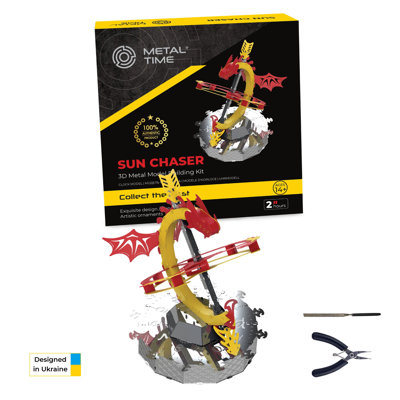
The earliest sundials known from the archaeological record are shadow clocks from ancient Egyptian astronomy and Babylonian astronomy. Presumably, humans were telling time from shadow-lengths at an even earlier date, but this is hard to verify. Once upon a time, a mighty Red Dragon, the Lord of the ocean, fell in love with the Sun, which made its waters sparkle like billions of diamonds. But the vast thickness of the sky separated them. The dragon asked his brother, the Lord of the air, to lift the waves of the ocean higher and higher. But he has never reached the beautiful face of the Sun. Then he decided to present all the treasures, stored at the bottom to the Luminary. But the rays of the Sun have not been able to break through the water column. In desperation, they turned to the Heavenly Emperor. And the Almighty answered them: a million years will pass when the world will change and the mountains will sink, and the bottom of the ocean will rise, and the sun will fall on the Earth, and only at this last moment will you be destined to meet. Since then, the Red Dragon has been watching his Love and counts down the years. No, this is not an ancient Asian legend. We just came up with it looking how the "Sun Chaser" prefabricated sundial works. You can come up with many of your versions. In Asian mythology, dragons are the foundation of everything. These creatures have many forms, but they represent the four elements: fire, water, air and earth. With their unlimited power over the Earth and the creatures inhabiting it, even the most powerful dragons are powerless against the invincible Time. Therefore, to create a model of a sundial in the shape of a dragon was an ingenious idea. As a result of a bold design idea, a beautiful composition was born that tells of a Red Dragon that wants to reunite with the Sun, but only by following it with the gaze of its jade eyes, counting down the hours of eternity. A beautiful legend has found its embodiment in metal, thanks to the efforts of the engineers of "Metal Time". The Metal Time team, while creating the Sun Chaser, was inspired by the history of human observation over time and Asian mythology. Of course, the basis of the sundial was a fixed piece that casts a shadow on the timeline, but our engineers and designers decided to improve this design. The result is an art object that will bring a lot of pleasure to both lovers of technical creativity and connoisseurs of beauty.
Decorative Puzzle Or Game
By METAL-TIME
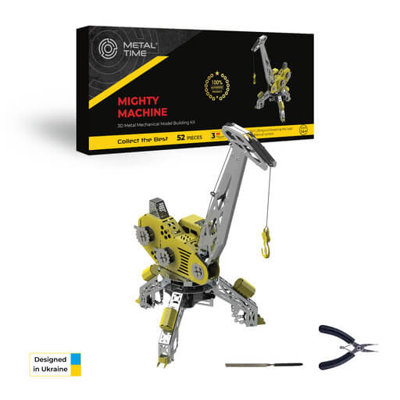
The first known crane machine was the shadouf, a water-lifting device that was invented in ancient Mesopotamia (modern Iraq) and then appeared in ancient Egyptian technology. Construction cranes later appeared in ancient Greece, where they were powered by men or animals (such as donkeys), and used for the construction of buildings. Larger cranes were later developed in the Roman Empire, employing the use of human treadwheels, permitting the lifting of heavier weights People began to invent devices designed to increase human strength from the moment of building activity of mankind. Therefore, it is impossible to say who invented the lifting crane. However, we can observe samples of large-scale work created using lifting machines. And the most impressive of them are the Egyptian and Latin American pyramids. And the installation of the idols of Easter Island maybe was not without the simplest cranes. Through centuries of technological progress, the lifting machines had a long line of reincarnations and turned into engineering masterpieces, but the basic principle of their operation remained the same: a heavy platform, a long jib, and a block system. This design allows you to solve several main tasks of the crane: to increase the mass of the raised cargo, the height to which it needs to be lifted, and the force attached to this process. Modern cranes have no limit in all these parameters. Therefore, this symbol of construction is an interesting model for technical creativity.The designers of “Metal Time” analyzed many types of lifting machines and as the basis for their new self-assembling model chose a prototype of the port crane. The model demonstrates a large-scale mechanism for working with big loads. Therefore, it was called “Mighty Machine”.
Decorative Puzzle Or Game
By METAL-TIME
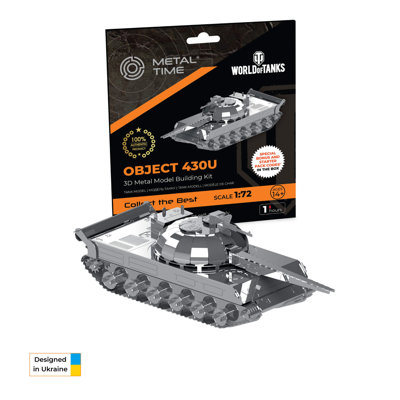
A prototype of this medium tank was developed from 1953 through 1957 to replace the T-54. Several prototypes were manufactured. Later, Soviet authorities wanted a tank with greater nuclear survivability and firepower. As a result, the project was discontinued in 1961, and the decision was made to develop the Object 432. After summing up the results of World War II and analyzing the effectiveness of all types of armaments, the Soviet government thought about the need to modernize its fleet of armored vehicles. First, there was a need to replace the T-54 medium tank, which would correspond to modern realities. Hence, in 1953, a new tank project was initiated, generically named “Object 430”. Several modifications of the fighting vehicle were developed under this name, which later became a basis for the development of “T-64”. In “Object 430” the changes concerned the location and configuration of the engine and the whole engine-transmission compartment. The engine was located across the driving direction in the aft compartment, allowing to expand of inner space for the 4-person crew and ammunition. A characteristic shape of the tank was a hemispherical turret with 248 mm armor at the front and a slot for the main gun - 100 mm D-54TS gun. There was also provision for a 14.5-mm anti-aircraft machine gun KPVT. "Object 430" in later modifications was successfully tested, however, it did not show a significant advantage over the obsolete “T-54”. In 1961 the project was stopped. Successful engineering solutions were taken over by the "Object 432", which eventually evolved into the mass-produced “T-64”.
Decorative Puzzle Or Game
By METAL-TIME
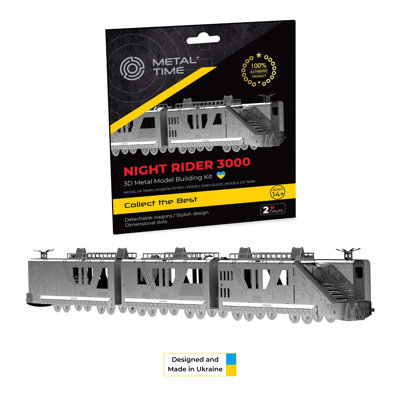
The Night Rider train is an imaginary train set in a fictional post-apocalyptic future. It crosses the desert only at night due to the impossibility of movement during the day due to the high air temperature. The Night Rider is a fully armored train often used to transport valuable passengers and cargo. Explore the thrilling world of the Night Rider 3000 DIY model kit, a captivating representation of an imaginary train set in a fictional post-apocalyptic future. This meticulously crafted steel model captures the essence of an armored train that braves the desert only under the cover of darkness, navigating the unforgiving landscape where daytime temperatures soar to extremes. The Night Rider 3000 is not just a model; it's a journey into a dystopian world where creativity knows no bounds. This DIY kit allows enthusiasts of all ages to bring the mystique of this fully armored train to life with their own hands. Each piece is precision-cut from high-quality steel, ensuring a satisfying building experience and a durable final product that can stand the test of time.

Transportation Decorative Puzzle Or Game
By METAL-TIME
Sea and ocean depths contain lots of secrets. So, underwater travel dreams have always been in the hands of inventors and engineers. Jules Verne's book 20 Thousand Leagues under the Sea was the first diesel punk novel dedicated to the underwater journey. She was a motivation to designers and engineers to come up with the submarine prototypes. Deep-sea vehicle prototypes appeared in the early Middle Ages, but it was until 1620 that the first successful submarine tests happened in England. Presently, underwater vehicles are the most intricate mechanical-electronic systems that can manage several months of underwater trips and explore the deepest depths of oceans in the world.
Lost at Sea Power Sculpture
By METAL-TIME
Free Delivery
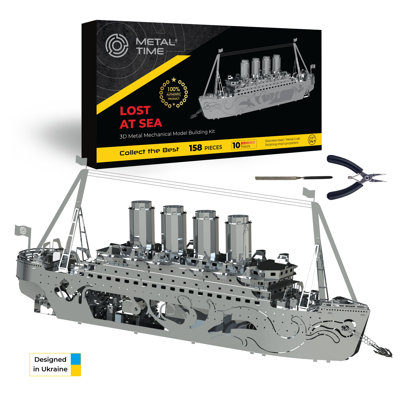
On a calm moonless night on 15th April 1912, the most renowned sea disaster in history happened 600 kilometers away from Newfoundland. The most innovative ship ever constructed by a human engineering genius crashed with an iceberg and sank, killing 1,517 passengers and crew. The "Olympic" class ship bore the name "Titanic" and turned out to symbolize the superiority of the forces of nature over the human mind. Regardless of the terrible accident that caused the disaster, the Titanic is worthy of admiration as shipbuilders' most perfect creation of the early 20th century.At the time of its launch, it was the biggest passenger steamer. Its length was 269 meters, an approximate equivalent of three football fields, while its width was 28 meters. The height from the keel to the top of the mast is 56 meters, which is approximately the height of a modern 20-storey building. The steamer's mass was 52310 tons. This is nearly 300 Boeing 747 aircraft.
Decorative Puzzle Or Game
By METAL-TIME
Free Delivery
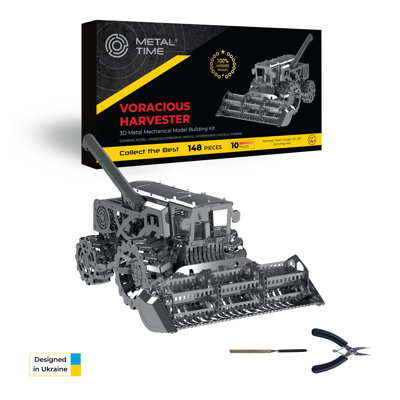
In 1826 in Scotland, the inventor Reverend Patrick Bell designed a reaper machine, which used the scissors principle of plant cutting; a principle that is still used today. The Bell machine was pushed by horses. A few Bell machines were available in the United States. In 1835, in the United States, Hiram Moore built and patented the first combine harvester, which was capable of reaping, threshing and winnowing cereal grain. Blue skies, endless fields, and hundreds of workers are harvesting. Peace and prosperity. Such idyllic paintings are symbols of prosperity in the cultures of many countries. However, technological progress makes its own adjustments to the established ideas. Now millions of agricultural workers have been replaced by machines. Their diversity is very great. They can sow, nurture, fertilize, irrigate, protect, and eventually harvest almost all crops. All these machines are united by one broad term - "combines". Of these, the most impressive mechanism is the combine harvester. One such machine can replace a thousand people on the field. Knowing no fatigue, the harvester cuts threshes the ears, separates the straw from the grain, forms sheaves, and unloads the final product. And it doesn't stop moving. There are harvesters capable of very complex operations with different types of crops. One thing unites them: these machines serve to save humanity from hunger. Therefore, the Metal Time team could not help but pay tribute to these wonderful mechanisms. "Voracious Harvester" is a DIY model of a combine harvester. A standard model of a cereal harvesting machine was taken as a prototype. The main parts that determine the appearance of the combine are the header and the bunker. The cutting blades and rotating reel are clearly marked on the header. The further processing process is hidden by the case, inside which the winding spring mechanism and the gear system are located. In front of the hull, there is a cab, in which there are schematically marked combine harvester controls - a steering wheel and a dashboard. The main part of the body is a hopper with a swivel unloading auger tube that pivots around the near end and can be extended sideways to simulate grain unloading.
Decorative Puzzle Or Game
By METAL-TIME
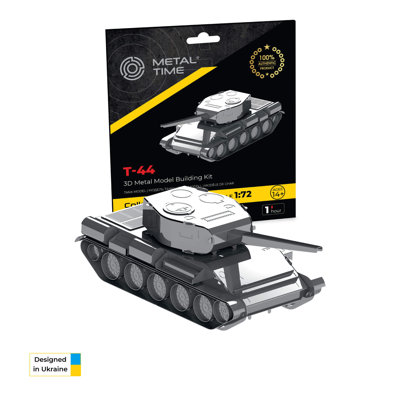
After the cancellation of the T-43, a replacement for the T-34 was still desired and work began on the T-44 in late 1943. Three prototypes were produced, with a 122 mm armed design being rejected. The 85 mm variant was accepted for production, which commenced in 1944 and the tank remained in service until the 1970s. The medium tank “T-44” could have become the best tank of World War II, but it never fired a shot on the battlefield. This combat vehicle was created in 1943 but never came into the front lines. In the last years of the war, the Soviet command realized that despite their quantity and decent mobility and reliability, the “T-34” tanks, even with the 85mm gun modification, were inferior to the best German armored vehicles - the “Tiger II” and “Panther” tanks. In head-to-head battles, the Soviet tanks had no chance due to their weak armor protection. Therefore, it was decided to create a tank with similar mobility and long-range capabilities as the “T-34”, but with significantly reinforced frontal armor. Thus, the “T-44” was born. It underwent significant modifications. The decision was made to abandon the Christie suspension, and increase the power of the gun while maintaining the advantages of a medium "cruiser" tank. The result was a powerful, fast, and well-protected combat vehicle capable of combining the armor protection of a heavy tank with the mobility of a medium one. Modifications were released with 100 mm and even 122 mm caliber guns, but due to the vehicle's weight increase, they had to be abandoned in favor of the 85 mm gun created based on the rapid-fire D5-T gun. Despite its worthy characteristics, the “T-44” was not put into mass production until the end of World War II, so as not to disrupt the production cycle of the “T-34-85”, which had similar parameters. However, after the war, the tank was produced in large batches and remained in service with the Soviet army until the 1970s.
Decorative Puzzle Or Game
By METAL-TIME
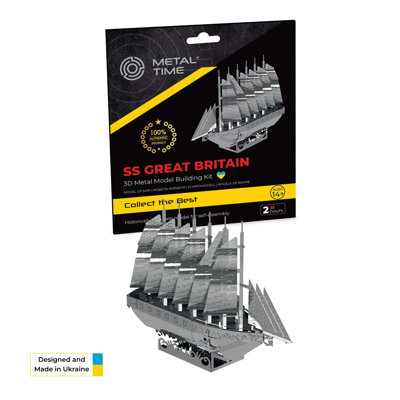
SS Great Britain is a former passenger steamship and it was the largest passenger ship in the world from 1845 to 1854. She was designed by Isambard Kingdom Brunel (1806–1859), for transatlantic service between Bristol and New York City. Great Britain is a former passenger steamship that was advanced for her time. She was the largest passenger ship in the world from 1845 to 1854. She was designed by Isambard Kingdom Brunel (1806–1859), for the Great Western Steamship Company's transatlantic service between Bristol and New York City. While other ships had been built of iron or equipped with a screw propeller, Great Britain was the first to combine these features in a large ocean-going ship. She was the first iron steamer to cross the Atlantic Ocean, which she did in 1845, in 14 days. When launched in 1843, Great Britain was by far the largest vessel afloat. But her protracted construction time of six years (1839–1845) and high cost had left her owners in a difficult financial position, and they were forced out of business in 1846, having spent all their remaining funds refloating the ship after she ran aground at Dundrum Bay in County Down near Newcastle in what is now Northern Ireland, after a navigation error. In 1852 she was sold for salvage and repaired. Great Britain later carried thousands of emigrants to Australia from 1852 until being converted to all-sail in 1881. Three years later, she was retired to the Falkland Islands, where she was used as a warehouse, quarantine ship and coal hulk until she was scuttled in 1937, 98 years after being laid down. After the initial success of its first liner, SS Great Western of 1838, the Great Western Steamship Company collected materials for a sister ship, tentatively named City of New York. The same engineering team that had collaborated so successfully on Great Western—Isambard Brunel, Thomas Guppy, Christopher Claxton and William Patterson—was again assembled. This time however, Brunel, whose reputation was at its height, came to assert overall control over the design of the ship—a state of affairs that would have far-reaching consequences for the company. Construction was carried out in a specially adapted dry dock

Decorative Puzzle Or Game
By METAL-TIME
Concorde is a tailless aircraft design with a narrow fuselage permitting a 4-abreast seating for 92 to 128 passengers, an ogival delta wing and a droop nose for landing visibility. Thrill of supersonic travel takes center stage with the SUPERSONIC LEGEND steel DIY model kit by Metal Time Models. Dive into the exhilarating world of aviation and celebrate the iconic Concorde, a true marvel of aerospace engineering. Crafted with precision and passion, this DIY model kit captures the essence of the legendary supersonic aircraft. The Concorde, known as the SUPERSONIC LEGEND, is brought to life through meticulously cut steel components that ensure a seamless and satisfying building experience. This tailless aircraft design features a narrow fuselage, allowing for a 4-abreast seating configuration catering to 92 to 128 passengers. The distinctive ogival delta wing and the droop nose, designed for enhanced landing visibility, are intricately represented in this model, paying homage to the unique features that set the Concorde apart.
Decorative Puzzle Or Game
By METAL-TIME
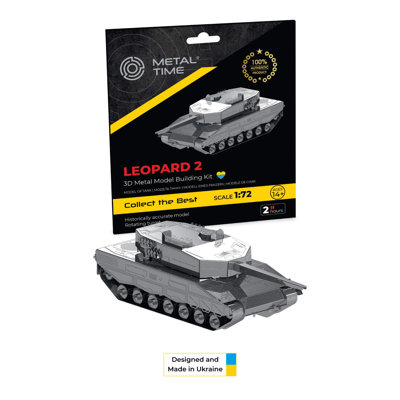
The Leopard 2 is a third generation German main battle tank (MBT). Various iterations of the Leopard 2 continue to be operated by the armed forces of Germany. The Leopard 2 is a third generation German main battle tank (MBT). Developed by Krauss-Maffei in the 1970s, the tank entered service in 1979 and replaced the earlier Leopard 1 as the main battle tank of the West German army. Various iterations of the Leopard 2 continue to be operated by the armed forces of Germany, as well as 13 other European countries, and several non-European countries, including Canada, Chile, Indonesia, and Singapore. Some operating countries have licensed the Leopard 2 design for local production and domestic development. There are two main development tranches of the Leopard 2. The first encompasses tanks produced up to the Leopard 2A4 standard and are characterised by their vertically faced turret armour. The second tranche, from Leopard 2A5 onwards, has an angled, arrow-shaped, turret appliqué armour, together with other improvements. The main armament of all Leopard 2 tanks is a smoothbore 120 mm cannon made by Rheinmetall. This is operated with a digital fire control system, laser rangefinder, and advanced night vision and sighting equipment. The tank is powered by a V12 twin-turbo diesel engine made by MTU Friedrichshafen. Following the end of the Gilded Leopard study in 1967, the West German government decided to focus on the Experimentalentwicklung (experimental development) in a feasibility study and to develop new components for upgrading the Leopard 1 and for use on a future main battle tank programme. At first 25 million DM were invested, but after the industry came to the conclusion that with such a low budget the development of the two projected testbeds was not possible, a total of 30 to 32 million DM was invested. The experimental development was contracted to the company Krauss-Maffei, but with the obligation to cooperate with Porsche for the development of the chassis and with Wegmann for the development of the turret.
Decorative Puzzle Or Game
By METAL-TIME
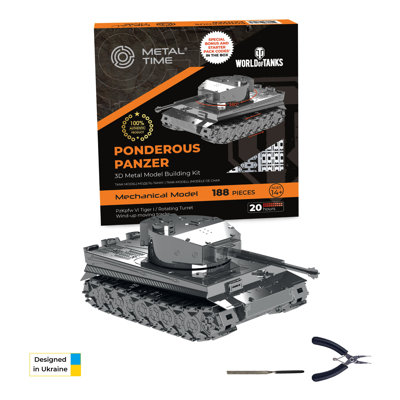
The Tiger was a German heavy tank of the Second World War. Development of a heavy tank design had been initiated in 1937, the initial design contract was awarded to Henschel. Another design contract followed in 1939, and was given to Porsche. Both prototype series used the same turret design from Krupp. The main differences were in the hull, transmission, suspension and automotive features. Summer 1942. Europe is lit. Nearly all countries in the region have found themselves drawn into Germany's scope of influence and are invading from all facades. The anti-Hitler coalition deals tangible blows to the Axis armies. For the first time in Germany, British bombs are exploded. The Americans block the Japanese fleet at Midway and the Solomon Islands. However, the attack on the Wehrmacht's military machine cannot is unstoppable. Because a new player, the Tiger heavy tank, went into the battle arena. This 24-ton vehicle with 88 mm main gun, 10 cm frontal armor, a duo machine gun, a mortar, and a 40 km / h travelling speed, turned out to be Third Reich's irresistible attacking force. "Tiger," the new technologies' embodiment of its time, still has significant interest among military equipment fans. This tank was movable, well-armed, and easily controlled using the steering wheel and pedals, just like a car. These factors worked in favor of the fact that the "Tiger" stayed in service until the end of the Second World War with virtually no deep modernization. "Metal Time" welcomes you to plunge into the legendary combat vehicles' history with the modular "Ponderous Panzer" model. The model retains all the original "Tiger's" features, including the "chess" arrangement of the rollers, the shape of the hull and turret, the command turret, and the gun. The tracks made up of individual tracks supplement realism and make you work hard when assembling them. The tank comprises a spring engine and can overpower small obstacles while driving. Cutting the set precisely does away with the likelihood of cuts in the event of assembling. The parts closely fit into each other and will not lead to joint problems.
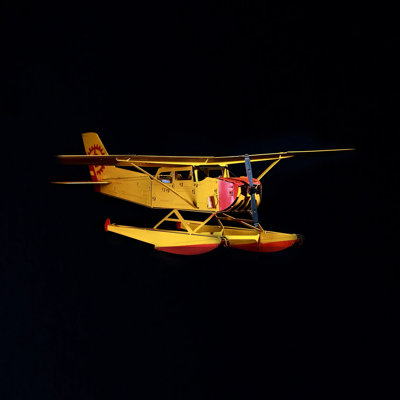
Breeze Drifter Seaplane
By METAL-TIME
The idea to cross a boat and an airplane came to the minds of people who carefully studied the world around them. Like the idea of aeronautics in general. Of course, their humanity borrowed from birds. The Frenchman Alphonse Pénaud filed the first patent for a flying machine with a boat hull and retractable landing gear in 1876, but Austrian Wilhelm Kress is credited with building the first seaplane, Drachenflieger, in 1898 I consider the beginning of the era of flying boats to be the 10s of the 20th century, although the first hydroplane took off in the air as early as 1909. It was created on the basis of its own engine by the American inventor Curtis. And already in 1913, the Ukrainian designer Grigorovich tested the M-1 hydroplane, which marked the beginning of the era of flying boats. The history of aviation honors the records set by seaplanes: two dead loops on Grigorovich's amphibian, the speed record of the Soviet Be-10 at 912 km / h, the world's largest flying boat, created in China already in the 20s of the new century. he designers of "Metal time" could not ignore this important milestone in the desire of mankind to fly and presented the modular model "Breeze Drifter". This is a prototype that incorporates the characteristics of a typical propeller hydroplane. Of course, it does not float, but it has a spring mechanism that drives the screws of the "engines".
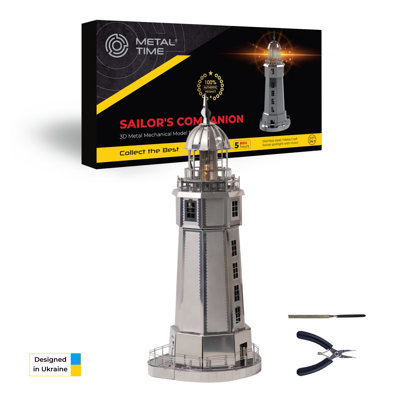
Sailor''s Companion Sculpture
By METAL-TIME
Free Delivery
This captivating lighthouse puzzle provides a uniquely satisfying experience for puzzle enthusiasts of all ages. Crafted to engage and challenge, it makes the perfect activity for individuals or families .

Free Delivery
From the Egyptian sundials, the British Isles' Stonehenge to the exquisite movements of John Garrison, Abraham-Louis Breguet, Carl Faberge and modern electronic chronometers, this way of increasing precision has not changed time itself. But it brought additional comfort to our lives.In the recent past, only a select few could afford to have a personal device for measuring time. Therefore, the center of each city was a public clock. They were located, as a rule, on clock towers, the sound of their bells was heard by the entire population. The architecture and arrangement of the towers were the subject of competition. Rich cities built high-rise masterpieces, poor villages were content with simple wooden turrets. This rivalry continues to this day. The tallest clock tower today is the Abraj Al-Beit Hotel in Saudi Arabia. Its height is 601 meters. The most famous and beautiful clock towers are London's Big Ben, Philadelphia City Hall, Warsaw Palace of Culture and Science and other works of architects and watchmakers.

Entertainment Decorative Puzzle Or Game
By METAL-TIME
Throughout mankind's existence, music has been the primary means for expressing emotions, building a psycho-emotional state both at individual and group levels. Initially, music creation was based on vibrating natural materials. While stationary objects were used for extracting rhythmic sounds, tonal sounds were extracted from string-like vibrations. The development took the human, technical thought millenniums before we could hear music in all its splendour. IT was up to until when Bartolomeo Cristoforo invented the piano in the 18th century in Italy that musical instruments attained their true beauty and complexity. This complicated keyboard-string mechanism has produced the finest musical masterpieces in mankind's history. "Royal" in translation implies "royal". This is the actual king with regards to musical instruments, the peak of mankind's technical genius.

Decorative Puzzle Or Game
By METAL-TIME
Construction of the tower began on 28 September 1843. Elizabeth Tower, originally referred to as the Clock Tower, but more popularly known as Big Ben, was raised as a part of Charles Barry's design for a new Palace of Westminster, after the old palace was largely destroyed by fire on 16 October 1834. Although Barry was the chief architect of the neo-gothic palace, he turned to Augustus Pugin for the design of the Clock Tower, which resembles earlier Pugin designs, including one for Scarisbrick Hall in Lancashire. The main clock tower in the most influential country of Europe, which ringing of bells the whole world listens to and the entire establishment checks the clock. Worthy of many mentions. Cinema, literature, billions of selfies, tens of billions of references. Undoubtedly, the Elizabeth Tower, the most recognizable part of Westminster Abbey and a symbol of London and the UK in general, has both cultural and technical value. One of the tallest clock towers in the world, with a height of 96 meters, was built in 1859. It has a unique clockwork that still works today and six bells, the main one weighing 13.7 tons and called Big Ben. Often the tower itself is also called that. The Elizabeth Tower is a worthy object for modeling and collecting. The main clock tower in the most influential country of Europe, which ringing of bells the whole world listens to and the entire establishment checks the clock. Worthy of many mentions. Cinema, literature, billions of selfies, tens of billions of references. Undoubtedly, the Elizabeth Tower, the most recognizable part of Westminster Abbey and a symbol of London and the UK in general, has both cultural and technical value. One of the tallest clock towers in the world, with a height of 96 meters, was built in 1859. It has a unique clockwork that still works today and six bells, the main one weighing 13.7 tons and called Big Ben. Often the tower itself is also called that. The Elizabeth Tower is a worthy object for modeling and collecting.

Decorative Puzzle Or Game
By METAL-TIME
Free Delivery
Obstacles do not block the path, they are the path! All-terrain vehicles designed for rough and soggy terrain. The key feature of this ATV is the large wheels with an onboard system to inflate or deflate them, which allows vehicles to travel through water, cross brushwood, scramble and climb up thin ice. This technology helps customers to overcome obstacles, to solve their pains, to value trust and collaboration. Many secrets of the planet would not have been discovered if people had not invented cars that could drive along the most difficult route. There are no obstacles for all-terrain vehicles since obstacles are their usual road. Powerful engine, large low-pressure wheels, independent suspension, sealed windows and doors - and you are ready to search for treasures where no man has gone before. ATVs have gone through many transformations, and now engineers are inventing more and more new configurations - from amphibians to rovers. Therefore, all-terrain vehicles are an eternal source of inspiration for technical creativity. The designers of ‘’Metal Time’’ took the Ukrainian ‘’SHERP’’ all-terrain vehicle with ultra-low-pressure wheels as the basis for the ‘’Trophy Hunter’’ self-assembly model. Such machines have long been working in remote areas of the planet. But the creators could not resist the temptation to give the model futuristic features, thanks to which it became like a character in a science fiction film about the conquest of other planets. Space opera lovers will love it.
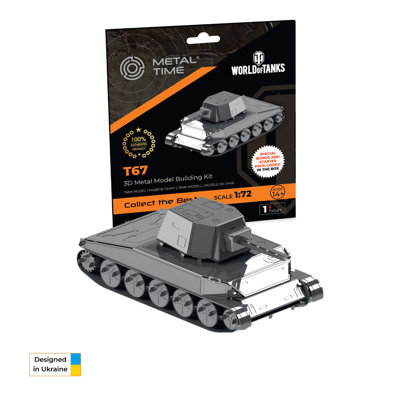
Model Car Or Vehicle
By METAL-TIME
Development started in the spring of 1942. After undergoing trials, the decision was made to replace the 57 mm gun with a 75 mm gun. The vehicle passed trials in the fall of 1942, but never saw service. The prefabricated scale model of the "Object 430" tank can be used as a souvenir, as interior decoration, and as a valuable prize for the fans of “WoT”. Also, it helps you to create installations, models, or reconstructions of tank battles of World War II. It will take a worthy place at the stand with the "Metal Time Workshop" and "World of tanks" collection of DIY models. But its main purpose – is technical creativity, joint modeling, development of handmade skills. Metal Time" assembly models encourage their owners to study the history of engineering and to develop skills in construction. Each of our models is assigned a unique serial number and it turns them into a subject of collection and exchange. The "Metal Time" Owners Club is a growing community of enthusiastic builders. The idea behind such vehicles was the high mobility of these "traveling guns" and the rapid deployment of firing points or batteries based on them. In tests the "T67" performed well and in 1942 it was accepted as a new basic model of “tank killers”. However, its combat life never took place. After modifications of transmission and platform "T67" was turned into another machine, which became a prototype for the legendary "M18 Hellcat". The failed "tank killer" "T67" had classic tank architecture and accommodated a crew of five. Despite its short life, this project was a milestone in the development of armored fighting vehicles and thus earned the attention and respect of all fans of construction and engineering history.
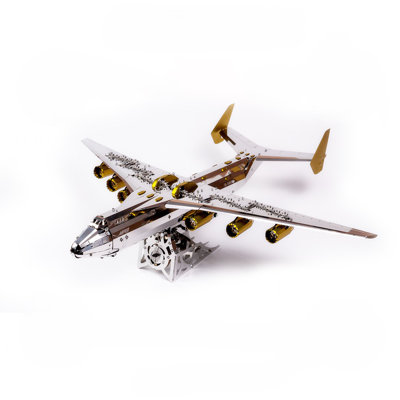
Free Delivery
Mriya - the world’s largest transport aircraft AN-225 built by Ukrainian engineers and aircraft builders. Its codename is translated from Ukrainian - a Dream. This aircraft was the flagship of the world aviation fleet. The dimensions of this aircraft were indeed unique: Its length is 84 meters, its height is 18.2 m. To understand these figures, imagine a six-story building with four entrances. The “Mriya” weighed 550 tons and could lift another 250. This is an absolute record among the heavier-than-air vehicles that have ever been airborne on the planet. "Mriya" could transport a herd of 42 elephants, for example. Or a million iPhones. Or a whole Boeing 737. In the history of the flights of the Mriya AN-225, there were episodes of transportation of giraffes, yachts, and parts of power plants. On its fuselage, the first Soviet «Shuttle» called «Buran» made its longest flight. At the end of February 2022, during the Russian attack, the Mriya was destroyed. but the dream won`t be demolished. But engineers of “Metal Time” revive the plane as self-assembly scale model. Here is the Exclusive Edition of the awards winning “Ukrainian Dream” model.
Decorative Puzzle Or Game
By METAL-TIME
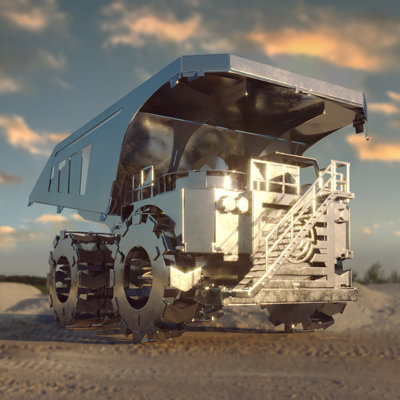
Climb aboard legendary mining truck which is a real monster for off-highway. It is specifically engineered for use in high-production mining and heavy-duty construction environments, including transporting construction equipment or mined ores and minerals. If you compare the world of cars to the animal world the dump truck should be represented by the elephant. If we make the comparison between the cars and animals, heavy special equipment will represent earths largest animals. A dump truck can be likened to an Elephant. It’s equally massive, solid, and operational. These super-vehicles are mercilessly crushing surfaces around 250 tons in a single trip. Think about 10 Tesla Model S and 10 Mercedes S600 cars in the same body! The engines in Dump Trucks have 2,700 horsepower, allowing it to pull a heavy load uphill on a hard rocky road at any time. The dump trucks’ wheel diameter is over 15 feet. If three tall enough people are to position themselves on each other’s shoulders, they will barely attain the wheel’s height. The drivers must climb 18-24 steps to enter the cab. When designing the Quarry Transporter, the Metal Time team used the common features of heavy mining trucks, the world's largest trucks. Their simple design, functionality, and load capacity motivated the designers of the Metal Time to develop roughness in constructing of the design. The Quarry Transporter is a rare vehicle, for sure. And it will take its rightful place in your collection.
Decorative Puzzle Or Game
By METAL-TIME
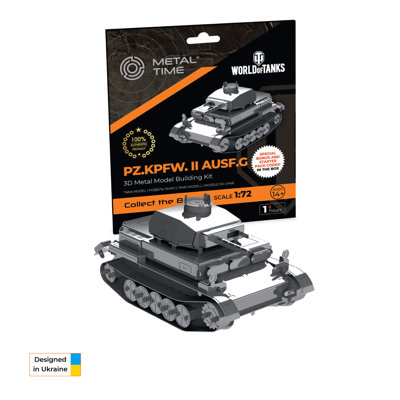
On June 18, 1938, MAN and Daimler-Benz received an order for an initial batch of 75 Pz II Ausf. G tanks. A prototype was manufactured in 1939. The vehicle was produced from April 1941 through February 1942, with a total of only 12 tanks built. World War II brought armored vehicles to the forefront, making them the main striking force. But it all began not with heavy, unstoppable, powerful machines with siege weapons, but with small maneuverable tanks. One of the remarkable examples of engineering creativity of the 1940s is the German "Panzer II Ausf G". A chain of modifications to the basic model, which was one of the most numerous tanks until 1942, led to its appearance. The "Panzer II Ausf G" significantly increased in speed. Unlike its rather slow predecessor, it could reach speeds of up to 50 km/h on the highway, which improves its mobility. Due to its good maneuverability, this light tank could perform tasks of escorting and providing fire cover for infantry even better. Its armor was sufficient to protect against small arms and mines, but artillery strikes became fatal for the Panzer II. The main weapon of the "Panzer II Ausf G" remained the 20mm automatic cannon and the 7.92mm MG-34 machine gun. The main protection was the turret design with ricochet angles, which allowed to soften or deflect enemy shell hits. The “Panzer II Ausf G” crew consisted of three people. Unlike the previous model, the driver and radio operator received viewports in the front and sides of the hull, improving the combat vehicle's maneuverability.
Decorative Puzzle Or Game
By METAL-TIME
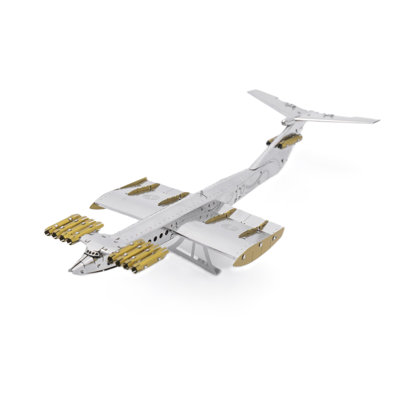
The KM (Korabl Maket, literally ""Model-Ship""), known colloquially as the Caspian Sea Monster, was an experimental ground effect vehicle developed in the 1960s. The KM was the largest and heaviest aircraft in the world from 1966 to 1988, and its surprise discovery by the United States and the subsequent attempts to determine its purpose became a distinctive event of espionage during the Cold War. It was tested on the Caspian Sea for 15 years until 1980, when it was destroyed following a crash caused by pilot error. There were no human casualties, but the KM was damaged and no attempts were made to save it, it being left to float before eventually sinking a week later. The KM was deemed too heavy to recover and has remained underwater at the crash site ever since. The KM remained the largest aircraft in the world during the entirety of its existence and is the second-largest aircraft ever built, behind the Antonov An-225 Mriya that flew for the first time in 1988. The Ekranoplan is a remarkable invention that combines the features of a glider, an airplane, and a boat into a single mechanism. This vehicle can fly over relatively flat surfaces such as deserts, fields, and water, utilizing air cushion effects generated by the airflow ascending off the surface. In 1960s a most powerful and big machine was built. It was a secret soviet project named “KM”, a soviet trial to make a warship from rare biggest ekranoplan on planet. The model known as the "Caspian Sea Monster" underwent several test flights, but after a series of accidents, it was deemed impractical. However, the audacity of the engineering concept laid out in the "Caspian Sea Monster" still captivates enthusiasts of large mechanisms and machines, inspiring designers to achieve new accomplishments. The engineers at "Metal Time" didn't overlook this remarkable object and created a model based on the core concept of the "KM" project. This aircraft had ten jet engines, short wings, and distinctive features in its tail section. It was designed for flights over water surfaces and could glide during takeoff and landing. All these features were incorporated into the self-assembly model of the "Caspian Sea Monster".
Decorative Puzzle Or Game
By METAL-TIME
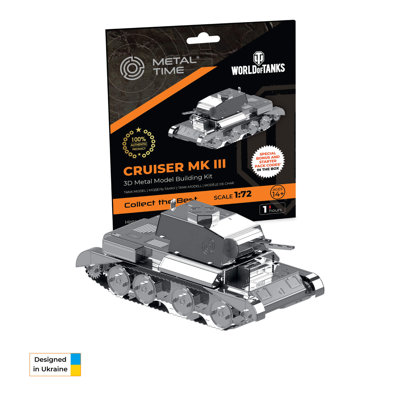
Developed by extensively upgrading two prototype M1931 Christie tanks purchased by the British Army in 1936. The vehicle was designed to be a fast, lightly-armored breakthrough tank. The modified design was deemed successful and became the basis for other cruiser tanks. Sixty-five vehicles of this type were built and saw combat in France and North Africa in 1940 and 1941. The British army began to prepare for the inevitable war at the beginning of the 30s. The industry was moving to a military footing, engineers were looking for advanced solutions for military equipment. American designer D. W. Christie created a chassis of four full-size rubber-coated rollers, planted on spring shock absorbers and two drive gears that move the trucks. This invention was so successful that it gave birth to several generations of tanks. One of the first was the English "cruising" tank "Cruiser Mark III". This light tank had a high speed, up to 50 km/h on a hard road, the ability to overcome obstacles up to 0.6 m high, and a powerful main gun - a 40 mm “QF 2 pounder” anti-tank gun. She was supplemented by a 7.7 mm “Vickers” machine gun. Under the ventilation grilles at the rear of the "Cruiser Mark III" was a 340 hp “Nuffield Liberty” 12-cylinder aircraft engine, superior in power to all similar combat vehicles of the time. The crew consisted of a driver, gunner, loader, and commander. With all these significant advantages, the tank had an important drawback: weak armor protection. Therefore, it was not used as an assault combat vehicle, but provided infantry cover, following more powerful tanks on the battlefield. The British lost dozens of "Cruiser Mark III"s in the fighting in France and brought these vehicles to less hot parts of the front. The era of the American “M4 Sherman” and British medium tanks in 1942 doomed cruiser tanks to oblivion.
Decorative Puzzle Or Game
By METAL-TIME
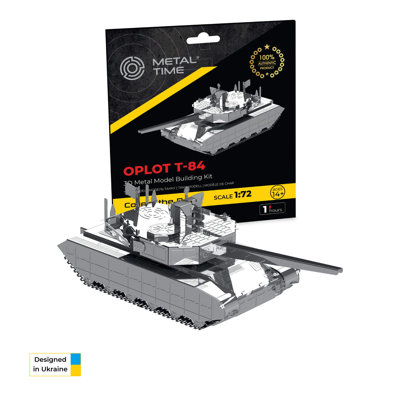
The T-84 is a Ukrainian main battle tank (MBT), based on the Soviet T-80 main battle tank introduced in 1976. The T-84 was first built in 1994 and entered service in the Ukrainian Armed Forces in 1999. The T-84 is based on the diesel-engined T-80 version, the T-80UD. Its high-performance opposed-piston engine makes it a fast tank, comparable to other modern MBTs with a power-to-weight ratio of about 26 horsepower per tonne (19 kW/t). The T-84 Oplot is an advanced version incorporating an armoured ammunition compartment in a new turret bustle. Ten of these entered Ukrainian service in 2001. The T-84-120 Yatagan is a prototype model intended for export, mounting a 120 mm gun capable of firing standard NATO ammunition and guided missiles. Main Battle Tank "Oplot" is the pinnacle of tank development in Ukraine and one of the best tanks designed and produced in series in the post-Soviet space. Based on the Soviet model T-80, "Oplot" underwent almost ten deep modernizations until it met NATO standards and became part of the family of advanced European combat vehicles. "Oplot" T-84 is equipped with a 1200 hp engine 6TD-2E, capable of reaching a speed of up to 70 km/h on the highway and operating at up to 450 km. The tank's armament consists of a main 125 mm gun, a 12.7 mm anti-aircraft machine gun, and paired 7.62 mm machine guns. Digital and analog equipment for the commander's console, targeting systems, and a multi-level protection system, including anti-nuclear protection, make this combat vehicle one of the effective European tanks. Successful tests in real combat conditions during the Russian-Ukrainian war only add to this model's score, as it has demonstrated its ability to actively engage in combat, protect, and effectively destroy enemy vehicles and personnel.
Decorative Puzzle Or Game
By METAL-TIME
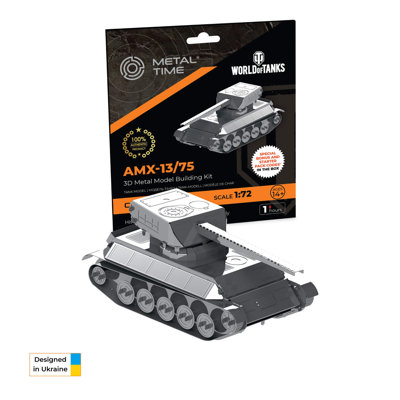
Maneuverable light tank with an oscillating turret and a 75 mm autoloader gun that could fire up to 10 shots per minute. At that time, the gun on this vehicle had superior penetration compared to the guns of most other medium tanks. The tank has a decent top-end gun and good dynamic performance. In the last years of World War II strategists and manufacturers of military equipment began to think about new generations of weapons. And one of the successful embodiments of the new concepts of armored fighting vehicles was the French light tank "AMX-13". Its first prototypes appeared in 1945 and its subsequent modifications were used in military operations until the XXI century. This maneuverable tank with a length of 5 meters and a height of 2.4 m originally possessed several unique design features. The most important of these was the "rocking" turret. The main design principle was that after the gun had fired, returning impulse was delivered to the turret and caused a new shell to move to the breech block of the gun and the loader mechanism to push it inside the barrel. This allowed automatic firing at a rate of up to 12 rounds per minute! Considering that such tanks were equipped with a 75-mm gun, this turned the tank into a vehicle for the continuous destruction of everything in the line of fire. Further modifications of the "AMX-13" were equipped with 100-mm and even 155-mm guns. In such a form it could compete with medium tanks and mobile guns. However, another difference of this tank was its speed. It could reach up to 60km/h on a hard surface (up to 400km), get over obstacles up to 60cm high, ditches up to 1.5m deep, and water obstacles up to 0.8m deep. Along with the brilliant characteristics, "AMX-13" also had disadvantages. It had weak armor, which was typical of light tanks, and the downside of rapid fire - the need to replenish ammunition. When the shells ran out in combat, the tank became unarmed and was often doomed to destruction.
Transportation Figurines & Sculptures
By METAL-TIME
Free Delivery
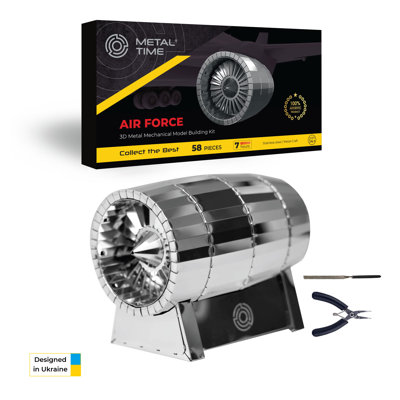
What are the similarities and differences between a windmill and a Boeing 747? This question is not at all absurd, and the main difference is that the mill does not fly and the plane does not grind grain. And the basic principle of their work is the same - the conversion of air energy into mechanical work. And the main mechanism of these different devices is the turbine - a system of wheels with blades.Immediately after the invention of the wheel, people began to think that it was possible to make wind and water do the work. Millennia of development of this idea have led humanity to power plants, turbojet engines and a huge leap in development.Turbines of different configurations and designs set in motion mechanisms, generate electricity, extract minerals, help us warm in the cold and refresh in the heat. Therefore, we can rightfully consider this invention one of the main results of the technical thinking of mankind.
Decorative Puzzle Or Game
By METAL-TIME
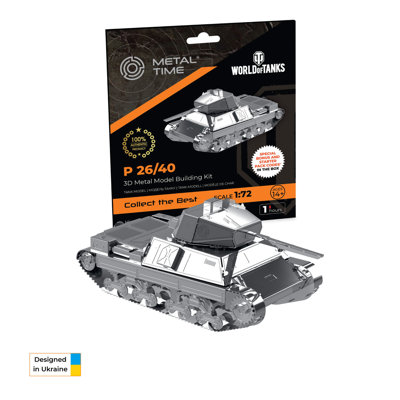
Development of this vehicle started at the end of 1940, but due to difficulties in finding a suitable engine, the first prototype was manufactured only at the beginning of 1942. Mass production was launched in 1943 in Turin. After Italy’s capitulation in the autumn of 1943, the tank entered service under the designation Panzerkampfwagen P40 737(i) and was used by the German reserve divisions as permanent fire positions. A total of 100 vehicles were produced. In the history of World War II, there are tanks that were "unlucky". Some of them were ahead of their time, some were hopelessly behind the times. One of these combat vehicles was the Italian heavy tank "P 26/40". Promising development stalled for years due to technological problems, and as a result, this tank did not become massive and did not have an impact on the battlefields. The "P 26/40" was one of the last riveted hull tanks in its class. In this, it differed from the similar geometry and basic parameters of the Soviet T-34 with its cast and welded parts and assemblies. The second feature was a semi-elliptical spring suspension with rollers assembled in carts. It seemed conditionally vulnerable, unlike more modern form factors. The third problem that was never solved was the engine. Nevertheless, the "P 26/40" was a powerful offensive combat vehicle, which had good armament and driving performance. With a weight of 26 tons, its speed was to 40 km/h on paved roads, and it could autonomously overcome to 280 km. Armor with a thickness of 40-60 mm provided protection against bullets, fragments, mines, and tangential impacts of shells. The main gun of the "P 26/40" was a 75 mm Ansaldo L/34 cannon and two 8 mm Breda machine guns. The crew of "P 26/40" consisted of three people. The commander was in the turret, and served as a gunner.
Remarkable Douglas Aircraft
By METAL-TIME
Free Delivery
The Douglas "Dakota" DC-3 is the most important commercial aircraft in human history. Since the end of the 30s of the XX century, it continues to fly 80 years later. This aircraft is the result of a brilliant engineering idea embodied by talented designers. Wherever this metal winged "dolphin" appeared: in the Amazon rainforests, and in the snows of Antarctica, and in the mountains of the Himalayas. And everywhere the sound of its engines carried the hope that the cargo would be delivered, people were saved, the lost were found. The DC-3 has many advantages. This is a landing gear design with a rotating wheel in the tail section, which allowed the aircraft to turn around its axis in a small area. It also provided a "nose-up" fuselage arrangement, which gave the impression that the Dakota was taking off, even just standing on the ground. This provided a short takeoff run. Powerful racks and wheels of the front landing gear withstood landing on any more or less flat surface. This allowed the DC-3 to be used on short unpaved runways, making it a versatile aircraft with a wide range of uses, from working farmland to smuggling in the South American jungle. Modifications of the Dakota also showed themselves during military conflicts, where they played the role of ambulance, landing and cargo aircraft, and even bombers. The Dakota DC-3 was not only an inspiration to pilots and engineers who built new aircraft in the image of one of the most reliable designs. He became the hero of many books and adventure films. Many of the modifications of the legendary monoplane continue their work, carrying cargo and people. The simplicity, reliability and legendary image of this aircraft inspired Metal Time designers to create the REMARKABLE DOUGLAS assembly model.
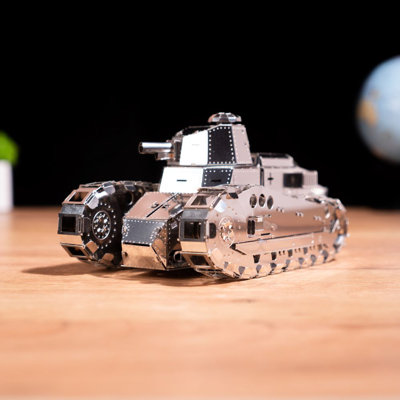
Decorative Puzzle Or Game
By METAL-TIME
Free Delivery
FT-17 is one of the best tanks of the First World War, the world's first serial French light tank, the layout of which is called classic (control compartment - in front, combat with a circular rotation tower - in the center, and motor-transmission - in the rear). Designed as an immediate infantry support tank in 1916-1917 by the renowned car manufacturer Louis Renault. By November 11, 1918, 3177 Renault tanks had been built. In numerous variants, the FT-17 was in service with more than 20 states and participated in various military conflicts. One of the most successful and effective tanks of World War I was the French FT-17, light tank. The car manufacturer Louis Renault was reluctant to build a tank at first. However, he was persuaded by Colonel Jean-Baptiste Eugene Estienne. And so, he designed and built the FT-17. The advantages of the FT-17 were immediately obvious, and in 1916 the new tank entered the battlefield. The FT-16 were for the first time used a rotating gun turret, giving the gunner a 360-degree view. And by placing the engine in the rear of the tank it dramatically increased room inside, the shooter and the driver separate spaces. This concept is still in use today. FT-17 weighed 6.5 tons, with a length of 5 meters and a height of 2.1 meters. The Renault engine provided a whopping 39 hp. That allowed the tank to reach a maximum speed of up to 8 km/h. Which was about the same speed as a marching infantry. The armament of the tank had two variations; one that consisted of a 37 mm machine gun, the other with a Blockhouse Schneider howitzer. In total, about 4 thousand FT-17 tanks were built, which made it the most massive serial tank of World War I.