Choosing the Best Light Bulb Just Got Simpler
For every lamp you can find the perfect light bulb.
When it comes to shopping for new light bulbs, there's no one-size-fits-all option. Your light bulb choice doesn't only affect the way your room is lit, it could also save you money on your lighting. That's why we've put together this handy light buld buying guide, so you can start lighting up your home in no time.
Our light bulb buying guide will take you through the whole process of shopping for new bulbs, as well as shed some new information on the more technical side of things. Below is a quick overview of everything you need to know:
- You need to make sure that the right bulb base that is compatible with the socket of your fixture.
- Lumens (Lm) determine the brightness of your bulb and can nowadays be used as an alternative to Wattage (W). This is because the different bulb technologies differ in light output, despite having similar Wattage.
- Colour temperature is measured on the Kelvin (K) scale, with bulbs on the lower end of this scale creating a cosy atmosphere and those on the higher end being better suited for rooms requiring good visibility.
- Innovation has led to the many different light bulb technologies on the market today, such as LED bulbs and compact fluorescent bulbs, each with their own benefits and drawbacks.
- Bulb shapes are not only a personal style choice. They need to be taken into consideration with your fixture to make sure that the bulb not only fits, but also directs light the way you want it.
Picking the Right Cap Fitting
The first thing to consider when buying a light bulb is which base you'll need. This is important because you need to make sure the light bulb base is compatible with your socket. There are several different types explained below:
Bayonet Cap
- Most common type
- Simple push and twist action needed to install
- Two main sizes: the B22d (22mm diameter) and B15d (15mm diameter)
- Many other bayonet cap variants used in numerous applications
Edison Screw Cap
- Named after inventor of the light bulb, Thomas Edison
- Simple screw action needed to install
- Most popular size [ES/E27] bulb with a 27mm diameter
- The most common variants are shown in the table below
Halogen & LED Spotlights (GU10 and GZ10)
- Simple push-fit or twist and lock action needed to install
- GU4 / MR11 and GU5.3 / MR16 are the most common for low-voltage fixtures, GU10 and GZ10 are the most common for mains electricity
- There is a subtle yet important difference between GU10 and GZ10 fittings so be sure to check your bulbs capability.
Getting the Right Brightness
Lumens (Lm) have a pretty complex definition, but to put it into simpler terms, they refer solely to the output of a light bulb. The more Lumens a bulb has, the brighter the light it gives off. Understanding Lumens can be handy when shopping for light bulbs, as Wattage is no longer a reliable way to gauge how bright or dim a bulb will be due to the introduction of newer technologies such as LEDs.
Nowadays, Lumens are listed for every bulb so you can always get a concrete idea of how to compare the brightness of any two light bulbs. Below is a table to help you measure brightness in Lumens:
Lumens and Wattages are approximate. Actual brightness will vary by product.
Colour Temperature
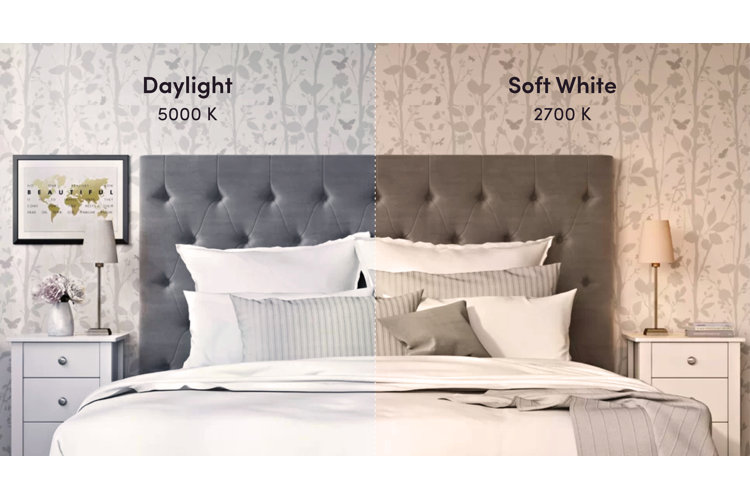
Colour temperature is measured in Kelvins (K) and is an important factor to take into consideration as it will really set the mood of the room you place the bulb in.
The Kelvin temperature scale ranges from yellow at the lower end to blue at the upper end with white light in the middle. You may want bulbs with a higher Kelvin score for rooms which require good working light, such as the kitchen or bathroom, and a lower Kelvin score for rooms you relax in, such as the bedroom or living room, to give it a cosier atmosphere. Below you can find a chart of Kelvin scores for different rooms.
Light Bulb Technologies
There are four main types of light bulb technologies used in domestic settings, each with their own characteristics, advantages and disadvantages. The following explanations should help you decide which is the right one for your home.
Incandescent Bulbs
- Works with an electrically-heated tungsten filament encased in glass
- Produces the familiar warm yellow glow we all know
- Slowly being phased-out for more environmentally-friendly alternatives due to their low energy efficiency
CFL Bulbs (or Compact Fluorescent Light Bulb)
- Considered the answer to the inefficiency problems of the incandescent bulb using between 1/5th and 1/3rd of the energy with a longer lifespan
- Produces a clear white light output, however CFLs with lower colour temperatures on the Kelvin scale are available nowadays
- Prone to reduced lifespan if used in short increments, so make sure you use them for lighting that will be kept on for a long time
Halogen Bulbs
- Just like an incandescent bulb but with halogen gas within casing which recycles burnt tungsten back into the filament, making it slightly more efficient in terms of light and cost
- Halogen bulbs share very similar characteristics to incandescents in terms of light and cost and therefore serve as a great alternative
LED Bulbs
- LED lighting is currently the rock star of light bulbs due to their superior energy efficiency and high performance, despite using only a fraction of the wattage needed for other types of bulb
- LED lights boast a life expectancy which can be as long as decades
- Super low running costs (LED bulbs may only cost as little as £1.20 a year to run if used for an average of 3 hours a day)
Note: These figures are estimates and are likely to vary from those stated in the table.
Light Bulb Shapes
Once you have your fitting, brightness, colour and technology sorted out, the last thing you may want to take into consideration is the bulb shape. Although the bulb shape is mostly down to your own personal preferences, each shape will give a slightly different lighting effect in terms of spread, angle or direction.
For example, a globe (or golf ball) shaped bulb will give close to 360 degrees of spread whereas a spotlight is great if you want the light focused on a particular object or area. Or if you're looking for something a bit more decorative, a candle bulb looks great with chandeliers and wall lights.
Aside from aesthetics, it's also important to keep the practicalities in mind. Pay attention to the bulb shape to be sure that it fits sensibly into the light fixture and doesn't protrude from the lamp shade. Use this list of available bulb shapes for reference:
Tip: Find more expert lighting tips with these guides:
- Your Go-To Guide for Everything Lighting
- IP Rating and Lighting Classifications Guide
- What to Consider When Buying LED Lighting
