Why It's Worth Investing in a Pressure Cooker
A little pressure in the kitchen is a good thing.
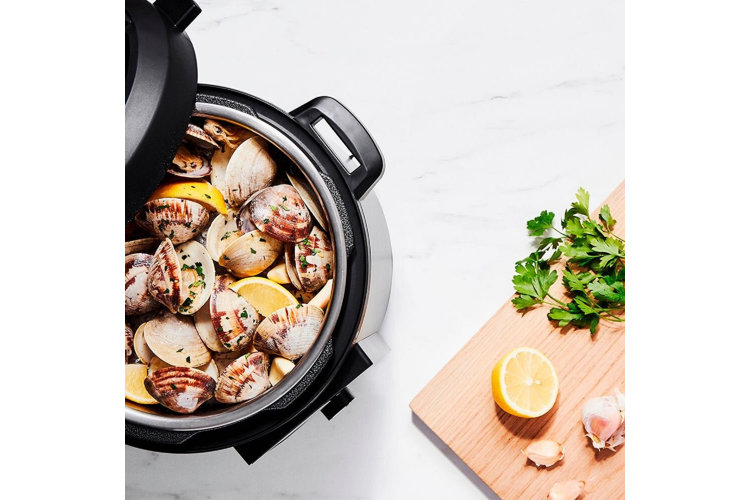
So you're a fan of cooking delicious foods. And you're also a fan of convenience. Then follow our guide to learn how to use a pressure cooker, a device that'll cook your favourite foods in half the time.
In This Guide
What Is a Pressure Cooker?
Types of Pressure Cookers
How to Use a Pressure Cooker
What Foods Can You Cook in a Pressure Cooker?
What Is a Pressure Cooker?
A pressure cooker is a large pot that uses pressure from trapped steam to cook food hotter and faster than other methods. They're mainly used for liquid-based dishes like soups, braises and boils but can be used to make rice or sauté vegetables (if your model has the appropriate setting). Depending on the recipe, a specific amount of water is added to the pot along with the food ingredients.
Pressure cookers are equipped with tightly fitting lids with rubber gaskets that lock shut to create an air-tight seal. They also have one or more valves that allow for the release of pressurised steam. A pressure indicator, usually a gauge or pop-up of some kind, lets you know when the pot has pressurised to your setting.
Pressure cookers can range in volume from 2 qt. to over 8 qt. but a standard size holds either 6 qt. or 8 qt. The standard sizes are great for family meal preparation, and most pressure cooker recipes call for a standard size pot.
Types of Pressure Cookers
Electric
Electric pressure cookers are incredibly user-friendly, so we recommend them for pressure cooking beginners. They have their own built-in heating systems powered by electricity. They're fairly heavy, with a stainless steel body and a matching lid equipped with a handle and one or more pressure-release valves. These cookers usually have two heat-safe handles on either side of the lid. Typically, the pot inside of an electric pressure cooker can be removed from the body for easy cleaning.
Most electric pots have control pads that allow you to set specific pressures, temperatures and cook times. Some have a setting that keeps food warm and many have buttons that automate the cooking of a variety of meals, from rice to fish.
Stovetop
If you’re looking for a pressure cooker that produces rich, flavorful food with a little more skill and attention required, the stovetop pressure cooker might be the one for you. Unlike electric pressure cookers, stovetop pots need to be heated externally. They’re often made from thick, durable stainless steel and have only one handle that secures to the lid while cooking.
Stovetop pressure cookers heat up and pressurise faster than electric pressure cookers, so they’re excellent at browning your ingredients and developing richer flavours. They lack much of the automation built into an electric cooker, so you must monitor temperature and cooking time yourself.
Tip: Worried about ingredients burning in a stovetop pressure cooker? Give it a small shake to prevent food at the bottom from sticking and overcooking.
Canners
Pressure Canners are large pressure cookers used to heat foods meant to be preserved in cans or jars. They’re often far larger than your everyday pressure cooker, capable of holding over 10 qt. Their lids are secured by screw clamps and their pressure indicators tend to be dial gauges located on the top of the lid.
These pressure cookers, though slightly impractical for everyday use and storage, are the only devices that can safely preserve low-acid foods, such as most vegetables, red meat, poultry and fish. Before a low-acid food is canned or jarred, it must be pressure canned so the botulism bacteria can't grow and produce potentially deadly toxins.
Botulism spores can survive being heated in boiling water, yet because pressure cookers can reach temperatures higher than water’s natural boiling point, a pressure canner can effectively kill them off.
How to Use a Pressure Cooker
Despite the complex science going on within a pressure cooker, they’re actually fairly simple to use.
Step 1: Fill a Pot With the Amount of Water Specified by the Recipe
Most pots have a water minimum of 1 cup and should at most only be filled ⅔ full with both water and ingredients. Some pots will have measurement lines inside however some won’t.
Step 2: Add your Ingredients, Close the Lid & Apply Your Pressure Settings
If you’re using an electric pressure cooker, your timer might be set automatically by the machine according to the presets you’re using. If not, the pressure indicator will let you know when your pressure setting has been reached and you can set your timer then.
If you’re using a stovetop pressure cooker, heat food on high until the pressure gauge indicates your pressure setting has been reached. Then, lower the heat to maintain your temperature and set a timer according to your recipe.
Step 3: Release the Pressure
Once your dish has cooked for the recommended amount of time, your recipe should call for either a rapid release of pressure or a natural release of pressure.
Rapid release: Pressure should be released right as the food is done cooking, before the pot has cooled down. The valve should be opened to release steam in bursts until all has escaped. We recommend using an oven mitt to move the nozzle that releases pressure as it can be hot.
Natural release: Allow your pot to cool and depressurise naturally. Simply remove your cooker from heat (an electric pot should do this automatically) and let it cool down.
Tip: Altitude does affect the cooking time of a pressure cooker. For every 1,000 ft. above 2,000 ft. elevation, increase cooking time by 5%. For example, if you live at 7,000 ft. - you should increase cooking time by 25%.
What Foods Can You Cook in a Pressure Cooker?
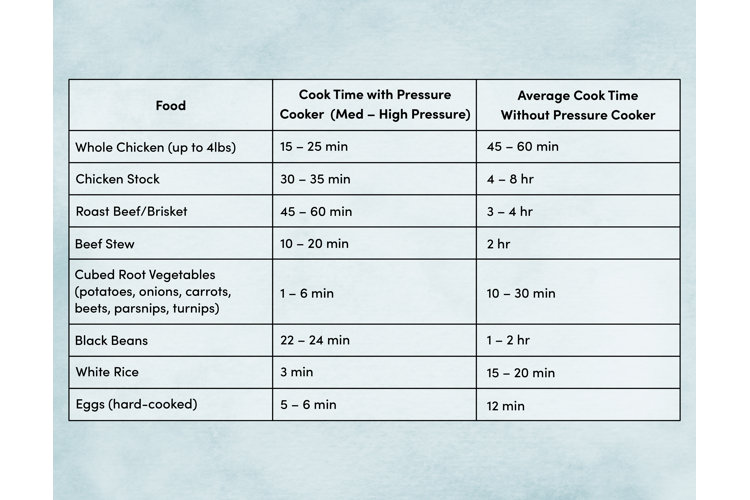
The answer is just about anything you might otherwise cook using water. You can make rice, stew, meat, soup, chili and even hard-cooked eggs in a pressure cooker. They’re excellent for making highly concentrated stocks. Try any recipe that has a long cook time just to see how much you can shorten it with your cooker.
Check out the chart above to see how much time a pressure cooker can save you when cooking many common foods.
Tip: Forgot to take meat out of the freezer before dinnertime? Frozen meats can actually be cooked without thawing in a pressure cooker – and all in a fraction of the time.
Enjoyed tis article? Then why not also check out:
- A Guide to the Best Food Vacuum Sealers
- How to Choose the Best Food Processor For Your Culinary Needs
- Chop, Chop! These are the Best Cutting Boards
